My very busy half-year is (hopefully) soon coming to an end: in October my mother (97) moved to a so called service apartment.
"Down-sizing", anyone?
I have been carting things here and there, to her new place and to me (and some to second-hand and the dump, too). But now I can see the end of all this – her old apartment is going on the market in a couple of weeks. (After I have taken one last load down here... - faamous lsat words?)
Last week I came home with a well-travelled suitcase, containing a jacket, an experimental moebius scarf (made by me) and some small yardage pieces (woven by her) – also some glass pieces for our growing museum, and some for re-homing.
(I really like how the back of the hood came out!)
Also, plans start to emerge for the Event of the Year: VÄV2017, this time at a place near me.
Oh yes – what happened in Bergdala, Sweden last Friday: grey/rainy weather with icy roads, the snowdrops got visible again after the rain, the assiettes got re-homed and the service workshop ordered a new part for my new computer. Even if the wind sometimes was hard, there were no earth-shaking events (but the aspen across the lane still looks like it will fall with the smallest gust of wind).
So there!
Showing posts with label Moebius. Show all posts
20/02/2017
15/05/2011
Slightly better?
Now it (the not very exciting) is finished into a circular scarf. The (Morse code) text says "make ends meet", from both directions.
A circular (or moebius) scarf can be worn in several ways:
On a cool summer evening, perhaps? (It can be used without a cat, but he really, really wanted to be in the picture...)
Just twice around.
Or, if it isn't needed, but you don't want to lose it (to the cat wanting to get back up, for instance):
I prefer the moebius finishing (a half-twist before sewing), but as this one has two distinct sides it could not be. But I have another idea...
A circular (or moebius) scarf can be worn in several ways:
On a cool summer evening, perhaps? (It can be used without a cat, but he really, really wanted to be in the picture...)
Just twice around.
Or, if it isn't needed, but you don't want to lose it (to the cat wanting to get back up, for instance):
I prefer the moebius finishing (a half-twist before sewing), but as this one has two distinct sides it could not be. But I have another idea...
11/03/2011
But how did...?!?
I first saw them on Weavolution, here and here, and was intrigued. I do know how to make V-shaped shawls - but they have two ends. These were closed!
I saw they were made on a Cricket loom, which is a rigid heddle loom ("loom", here, means it has both warp and cloth beams).
Hmmm.
I saw how one could make one by using a rigid heddle with body tension (thus being able to apply warp tension without a cloth beam), but I could not think of a way to make them on a "beam" loom.
(I should say: I have no idea how Lydia Kendrick makes hers!)
Until the lightbulb went on: I have a sandpaper beam! As the whole meaning of the sandpaper beam is to maintain tension between warp beam and freshly woven cloth... eureka! (I hoped)
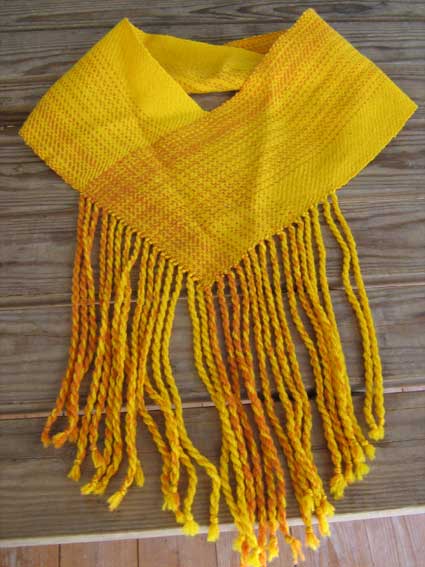
So I decided to try: measured my head (65 cm should be enough), put on a 15 cm wide warp, and started weaving. As the bobbin run out after 62 cm, that would have to be enough... and I started the V part. (This is when the Moebius shape is put in - the yellow side is "outside" on the loom, so it should be on the "inside" when the V is started)
It looked like I had used a too light beat, and had it been more than 120 ends I might have scrapped it - . It is so much, er, "fiddlier" to find the corredt end and getting the weft tension right than one would think...
After cutting the warp, I wrestled the thing off the sandpaper beam (after taking it off, of course), and, here it is, fresh off the loom:
Honestly, it did not look promising... but after burling and mending (more than I care to tell you - when weaving on an AVL, always remember to step decisively on the left treadle!), fringe twisting, wet finishing and pressing it looked nice enough that I wore it to the guild meeting yesterday!
(Maybe I should have pressed it again - it has sat in a drawer overnight)
Now (the day after) I can say it was a fun and fast project - maybe I should make more?
I saw they were made on a Cricket loom, which is a rigid heddle loom ("loom", here, means it has both warp and cloth beams).
Hmmm.
I saw how one could make one by using a rigid heddle with body tension (thus being able to apply warp tension without a cloth beam), but I could not think of a way to make them on a "beam" loom.
(I should say: I have no idea how Lydia Kendrick makes hers!)
Until the lightbulb went on: I have a sandpaper beam! As the whole meaning of the sandpaper beam is to maintain tension between warp beam and freshly woven cloth... eureka! (I hoped)
So I decided to try: measured my head (65 cm should be enough), put on a 15 cm wide warp, and started weaving. As the bobbin run out after 62 cm, that would have to be enough... and I started the V part. (This is when the Moebius shape is put in - the yellow side is "outside" on the loom, so it should be on the "inside" when the V is started)
It looked like I had used a too light beat, and had it been more than 120 ends I might have scrapped it - . It is so much, er, "fiddlier" to find the corredt end and getting the weft tension right than one would think...
After cutting the warp, I wrestled the thing off the sandpaper beam (after taking it off, of course), and, here it is, fresh off the loom:
Honestly, it did not look promising... but after burling and mending (more than I care to tell you - when weaving on an AVL, always remember to step decisively on the left treadle!), fringe twisting, wet finishing and pressing it looked nice enough that I wore it to the guild meeting yesterday!
(Maybe I should have pressed it again - it has sat in a drawer overnight)
Now (the day after) I can say it was a fun and fast project - maybe I should make more?
08/02/2011
About rules, written and un-
Many years ago I went to Svensk Hemslöjd to ask if they would like to sell my scarves/shawls.
They did not, for two reasons: 1. I used colours (colours, not dyes!) that did not "exist in nature" and 2. they were not brushed, which made them "feel like fabric".
(I have a problem, here - can some native speaker pls help? "Fabric", above: she meant they felt like material used to sew garmants. What is the most correct word to use for this?)
The shawls I had brought were woven of the most soft and nice worsted (2/2/32 worsted count, spun in Scotland - I still have some of the yarn, but the labels are long gone), had a lace pattern that I also don't know in English (see below), but that Cyrus translates as "mosquito netting", and were (of course!) not brushed.
I had a couple of colour "lines" - I remember one warp was from several shades of burnt orange, with a different orange weft for each - another was turquoise (again several shades). I believe there were two more colur combos - all long gone, no pictures, but this was the idea:
Not even then I was naive enough not to know that there were unwritten rules for what would pass as "hemslöjd", but I had never thought the choice of colour would be one of them. After all, I had used a traditional Swedish weave structure, a traditional, um, "layout" (ordinary straight shawl, with traditional fringes, "ordinary" length and width). And to my mind, they were not "fabric", as they were far too open to sew with...
But - some people never learn... A couple of years later, I came back with different shawls. This time I had some V-shawls, and some I had sewn into a moebius shape. (This wasn't one of them - this was the sample. It is a lot "worse for wear", but it must be over 20 years old now)
In the moebiuses (??) I had experimented with warp face -> even-sided -> weft face structures, for a) more visual interest than plain weave or 2/2 twill and b) to make the join visually seamless. Something along these lines (though I believe it was slightly more complex):
Yes. Or, rather, no. These were not "traditional", so: no thanks.
That was the last time I tried to sell anything through Hemslöjden.
(- I have sold many Moebiuses over the years. It is a very good shape: with the right length it can be worn several ways, according to temperature: One turn over the head and the second turn around the neck; two turns around the neck; when you get warm, use only one turn and you get cooler without risking to drop it. Or it can be hung as a sash - over one shoulder and diagonally down to the waist.)
The next time I had problems with unwritten rules was when I decided to enter a flax spinning contest.
It appeared as if there were no rules - on asking, I was told "there are so many points to consider". After I had won, one of the judges told me that, "properly", I should not have - but the nominal winner had used a spinning wheel that was not traditional. (She had a Louet, with a big orifice, and everybody "knows" it is
"impossible" to spin fine on one of those - thus, her result was a pure fluke. I had an antique Swedish wheel.)
Several years later, after moving down here, I entered another flax spinning contest. The idea, said the invitation/rule sheet, was to educate the public. Good, I thought - looking forward to some kind of open judging, or at least some explanation afterwards. It would be nice to know what constitutes a good linen yarn.
But... not. Even though I came second, I still don't know what flax spinning judges look for in a spinning contest, or a linen yarn. On asking, I was told that I should be happy I had got good points.
(Having a background including dressage riding, I know it it perfectly possible to have judging protocols broken down into several smaller steps, with the possibility for judges to write comments. Which they often do.)
Now, we have the Handwoven/Väv Garment Challenge. Apparently, if one asks Handwoven, one will be told that weaves of more than 8 shafts will not be considered. Note: I have NO problem with that! But: why is this not in the rules?!? Considering the rules already are almost two screens long, one line more would not make that much of a difference.
They did not, for two reasons: 1. I used colours (colours, not dyes!) that did not "exist in nature" and 2. they were not brushed, which made them "feel like fabric".
(I have a problem, here - can some native speaker pls help? "Fabric", above: she meant they felt like material used to sew garmants. What is the most correct word to use for this?)
The shawls I had brought were woven of the most soft and nice worsted (2/2/32 worsted count, spun in Scotland - I still have some of the yarn, but the labels are long gone), had a lace pattern that I also don't know in English (see below), but that Cyrus translates as "mosquito netting", and were (of course!) not brushed.
I had a couple of colour "lines" - I remember one warp was from several shades of burnt orange, with a different orange weft for each - another was turquoise (again several shades). I believe there were two more colur combos - all long gone, no pictures, but this was the idea:
Not even then I was naive enough not to know that there were unwritten rules for what would pass as "hemslöjd", but I had never thought the choice of colour would be one of them. After all, I had used a traditional Swedish weave structure, a traditional, um, "layout" (ordinary straight shawl, with traditional fringes, "ordinary" length and width). And to my mind, they were not "fabric", as they were far too open to sew with...
But - some people never learn... A couple of years later, I came back with different shawls. This time I had some V-shawls, and some I had sewn into a moebius shape. (This wasn't one of them - this was the sample. It is a lot "worse for wear", but it must be over 20 years old now)
In the moebiuses (??) I had experimented with warp face -> even-sided -> weft face structures, for a) more visual interest than plain weave or 2/2 twill and b) to make the join visually seamless. Something along these lines (though I believe it was slightly more complex):
Yes. Or, rather, no. These were not "traditional", so: no thanks.
That was the last time I tried to sell anything through Hemslöjden.
(- I have sold many Moebiuses over the years. It is a very good shape: with the right length it can be worn several ways, according to temperature: One turn over the head and the second turn around the neck; two turns around the neck; when you get warm, use only one turn and you get cooler without risking to drop it. Or it can be hung as a sash - over one shoulder and diagonally down to the waist.)
The next time I had problems with unwritten rules was when I decided to enter a flax spinning contest.
It appeared as if there were no rules - on asking, I was told "there are so many points to consider". After I had won, one of the judges told me that, "properly", I should not have - but the nominal winner had used a spinning wheel that was not traditional. (She had a Louet, with a big orifice, and everybody "knows" it is
"impossible" to spin fine on one of those - thus, her result was a pure fluke. I had an antique Swedish wheel.)
Several years later, after moving down here, I entered another flax spinning contest. The idea, said the invitation/rule sheet, was to educate the public. Good, I thought - looking forward to some kind of open judging, or at least some explanation afterwards. It would be nice to know what constitutes a good linen yarn.
But... not. Even though I came second, I still don't know what flax spinning judges look for in a spinning contest, or a linen yarn. On asking, I was told that I should be happy I had got good points.
(Having a background including dressage riding, I know it it perfectly possible to have judging protocols broken down into several smaller steps, with the possibility for judges to write comments. Which they often do.)
Now, we have the Handwoven/Väv Garment Challenge. Apparently, if one asks Handwoven, one will be told that weaves of more than 8 shafts will not be considered. Note: I have NO problem with that! But: why is this not in the rules?!? Considering the rules already are almost two screens long, one line more would not make that much of a difference.
Labels:
colour,
cultural differences,
Moebius,
sharing information,
spinning
08/06/2009
Plan B

I had warped for 5 message shawls - or so I thought. Obviously the messages (and the fringes) had got a bit longer than what I had reckoned - but the thrums were a bit too long just to cut off.
So I decided on Plan B - and I can always use another shawl myself, right?
Of course it should have a message. KORT (short) ought to fit.As a joke on myself I let the marks get shorter along the text. The closing T (long) is only two picks longer than the first "short".

When cut, the cloth measured almost 85 cm. I had decided to join the ends with the fringes going through loops - and now I decided to make it into a Moebius strip. So, first the ends got hemmed, the fringes twisted with temporary slip knots.
I made loops on both the white and the black hemmed ends. (Have you ever wondered why there is "buttonhole twist" threads to be had, try making 36 buttonhole stitched loops with ordinary sewing thread - then you'll know...)
A Moebius strip is a loop without outside (or inside). It is made by taking a long strip, making a half turn, then joining the ends. So I made the half turn, then threaded the white fringes through the loops on the black end, and vice versa. - Maybe I should not have used temporary slip knots, it seems I lost a bit of the original twist when the fringes were tied together two-by-two.

All this done, it was time for the wet finishing. As usual, the fringes came out the washing machine in one big mess... but it was a lot easier to un-tangle fringes that are attached at both ends :-)
It can be worn long, with the knots on the fringes at the looped end - or it can be worn short (as in the top picture)
Subscribe to:
Posts (Atom)