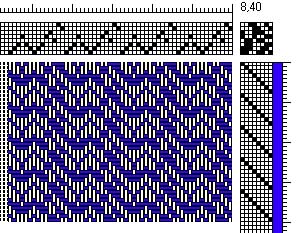
Can "goose-eye" be combined w other structures?
Well, not all of them... at least not if using 4 shafts.
Showing posts with label weave construction. Show all posts
29/11/2017
22/09/2016
Double layers and "clean cuts"
Jean's comment on the differences on right and left (or top and bottom) made me do what I have thought to do for a long time: can the differences be avoided?
So I started with my "normal", looking at both sides:
Seeing that both sides are the same (one side clean, the other jagged) made me suspect that it can't be "fixed", as long as one is interested in a reversible result.
By adding (or subtracting) two ends at the jagged side, one can get clean cuts at both sides.
... but the back will then get both sides jagged:
Personal conclusion: until I feel the urge to take the exchanging layers to twill, I will continue to weave two picks per layer, and live with the un-equal sides because of the reversibility of the result.
Others may have other ideas...
Labels:
block weave,
double layers,
weave construction
13/09/2016
Triple layers - variation for easier weaving
Yesterday I stopped before doing what I always do: rearranging the treadling for easiest actual weaving:
Unless I have very fat yarns in my double (in this case triple) cloth, I try to arrange the treadling so that I can do two picks per shuttle (layer).
It is so much faster to do two picks before having to change shuttles...
(Yes, it shows in the end product:
These are two not quite focussed pictures of double-layer shawls.
They are approximately 2 x life size, and has the ends one-by-one and the picks two-by-two.
The warps are a combination of cottons, 16/2, 20/2, 22/2 and maybe a few 30/2.
The wefts are of course only one quality per shuttle, but I don't remember which grist. The sett was probably somewhere about 10 ends/cm (25 epi).
And no, I haven't tried it for three layers.)
So: here is what I would do before sitting down to actually weave.
First: use the existing tieup, but rearrange the colour sequence.
Next: rearrange the new treadling to straight:
As I weave from bottom to top, and have an overhead beater, this is the treadling I would use, namely start in the bottom layer, working up to the top layer, as seen in the widest section of the warp.
(Yes, on the loom there will be "gaps" where the layers change. I have never seen these gaps after wet finishing - see pictures above.)
Hm.
Remembering one of my doodlings from yesterday (which did not reach publication) - another way of making more-than-two-different narrow stripes - a shift in the warp sequence can accomplish that:
Of course it depends on the actual colours used etc etc, but something to consider, perhaps?
Labels:
block weave,
efficiency,
plain weave,
triple layers,
weave construction
12/09/2016
A challenge? - I always love a challenge...
So, the question was: how to make a three-layer weave, with warp-wise layer changes?
(and preferably on 12 shafts "only")
This is how I approached the problem:
(To all Swedish readers (and Ellen: hi, Ellen!): note that all tieups are for rising shed. This means that the layers/colours will be reversed if the tieup is used "as is" for a CM.)
Started with a three-layer (three independent layers) weave - for plainweave layers, that takes six shafts.
For instance like this:
(To make things clearer in my mind, I threaded the first (turquois) layer on shafts 1-2, the next (purple) on shafts 3-4, the third (red) on shafts 5-6. When the construction is ready, the threading can be rearranged for easier threading.)
I made the top layer turquoise, the middle layer purple, the bottom layer red-orange. The three layers do not interact at any point. (Note that the difference in nuances between warp and weft makes It easy to see that the bottom, red-orange, layer has a correct interlacement, even without using the "back view".)
Now, we wanted a lengthwise (warpwise) layer exchange. I decided the left hand side is a good place. Thus, to start the construction, assume another "block" of the same threading and colour to occur at the left side. Like so (left pic):
The same threading on a new set of shafts (= a new block), with the same colour order. We want to shift the layers, so I let them "cycle": the middle, purple, layer goes on top - the bottom, red, goes in the middle and the top, turquoise, layer has to go to the bottom.
OK, I hear you: how do I do this?
I am using Fiberworks PCW (silver, if that matters).
By clicking in the drawdown, I can get ends/picks to the top (for instance).
Middle pic above: all purple threads, both warp ends and picks, are taken to the top.
Next is to fix the interlacement: right-hand pic above. Note that the interlacement should be a continuation of the purple plainweave in the right-hand (first) three-layer block.
Now to fix the middle layer, the red-orange one. Click all ends and picks so that they are under the purple layer, but on top of the turquoise (left picture below). Fix the interlacement - easy because of the difference between the red and the orange - right-hand picture below.
For the bottom (turquoise) layer, it is easier to use "back view".
As it happens, all turquoise threads are already at the bottom... fix the interlacement, go back to "front" view again:
Unfortunately, all the 12 shafts are now used.
As we want another stripe, we add another block (6 shafts) - now the total is 18.
The same procedure again: make the red-orange layer top, the turquoise will be in the middle and the purple layer will go to the bottom layer:
In the hopes that I had missed something important, I let the software analyse my result - alas, I had not: it really takes 18 shafts to do this.
But...
What if: let one of the layers stay in the same position for two stripes: this will reduce the goal to two blocks. With the three "open" layers on the right-hand side of different widths, and several narrow-ish stripes on the left-hand side... voilà, only 12 shafts. An alternative?
(As I, personally, prefer straight threadings whenever possible, I rearranged it for this final picture, showing both front and back:
(Remember: click pictures to enlargen)
Labels:
block weave,
plain weave,
triple layers,
weave construction
07/09/2016
Dräll pulleys and opposite tie-ups, again
So is it possible to use dräll pulleys for other than two-block "opposite" weaves?
To refresh your memory, here is one illustration from my web page on dräll pulleys, with 6 shafts mounted:
The question came up in another context, and I tried to construct some examples.
Starting with a 2/2 twill - this is one "normal" way to thread and tie it up:
(The red line represents the position of the dräll pulley, the line which makes the mirror for the opposite tieup)
As can be seen, that tieup will not work. Starting from the left, the first column will work. The second will not, as shafts 1 and 4 both go up (in the Swe notation), while shafts 2 and 3 both go down). Third column is "opposite", fourth is not.
So what can be done? We need to do something to both column 2 and 4, trying to get them "opposite". One way is this:
By changing the threading, we have also changed the tieup, which is now compatible with the dräll pulleys: it is now "opposite". (Note that this also prevents a true tabby, as the threading no longer follows the odd-even rule).
Next try, an 8-shaft even tieup (by "even" I mean that all sheds have half of the shafts up, half down, in various combinations - see a discussion on "even" weaves here)
Started with the leftmost column - and got the fourth correct as a bonus.
However much I tried, I could not fix more than 4 columns/treadles.
Maybe I could modify the pattern some, and still like the result? So I marked all the ties that conformed with the rule:
Started to take out/put in ties in the possible positions... this was the best result I could come up with:
Would I weave this? No, but then, I am on a countermarche...
Compare it to my starting point:
I tried various other even tieups with much the same results, and in the end I decided that there is a good reason the pulleys are called "dräll" pulleys: they are excellent for two-block "opposite" structures! For all the others, there are countermarche looms...
Labels:
counterbalance looms,
dräll,
twill,
weave construction
21/05/2016
All you need to know about counterbalance looms?
As it is continually said that it is "impossible" to weave "unbalanced" sheds on counterbalance looms, I decided to make an illustrated guide to why it is actually perfectly do-able...
So, now there are two new pages on my website - one about how an ordinary Swe style 4-shaft CB loom with horses works, and another one about how dräll pulleys work, and what they can be used for.
Labels:
counterbalance looms,
looms,
weave construction
30/04/2016
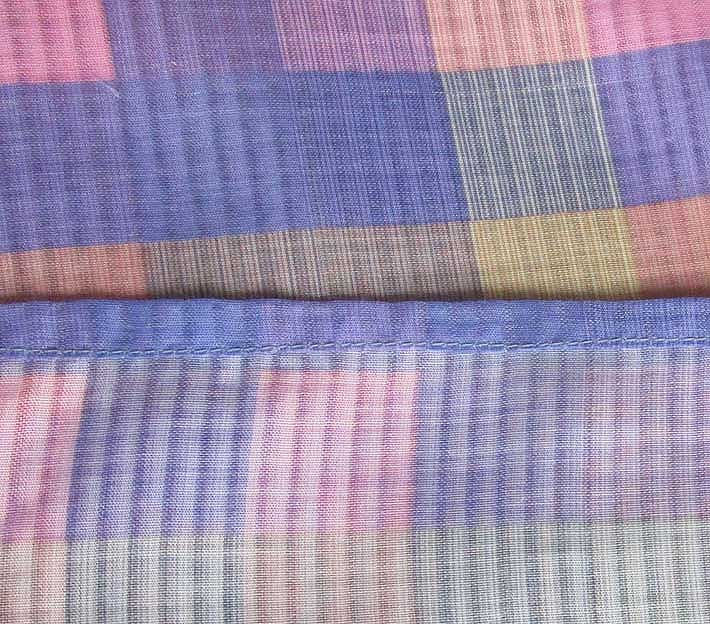
A mystery cloth
This is a top of my mother's:
She made it ages (20? 30?) years ago, from a remnant. Assumed cotton, but who knows, these days? It has a lovely hand.
I have always liked it, and always thought, carelessly, that it must be some kind of crackle-ish structure (although, who would have thought industry would make crackle-ish fabric for yardage?).
So, getting one step nearer:
Hm. Compare front and back ('cos this fabric has distinctly different faces).
Hm. Face side again:
It certainly looks like plain weave, with a pattern of crammed-and-spaced warps... except is does have blocks of some sort?
Hm. Double hm. We can (sort of) see that the warp colours appear to change when the (weft) blocks change.
Or, that's what I think - 'cept I can't understand how, as the whole shebang still looks like plain weave... and the back doesn't really show any weft "blocks"?
The fabric can have been rotated, of course: white warp, coloured weft.
How many colours in the weft, then? (How many wefts can a modern loom handle? And it also has to handle the crammed-and-spaced effect.) And why weave something so complicated, when a multi-coloured warp and constant # of picks per cm would be so much easier? - could it be because this particular mill just had got this very ultra-modern loom, capable of handling a gazillion of wefts and varying the beating-up force - a kind of "because I could"-result?
Against the light (and now all pics start to be blurry... try holding a piece of almost see-through fabric I one hand, while trying to get your camera to focus with the other hand, and you'll see what I mean. First pic to illustrate my point... :-)
And in the last picture it looks like the cramming shifts... regardless of if in the warp or weft direction, HOW??? (click pics to biggify)
Well.
I still think it looks like plain weave, crammed-and-spaced, except it appears impossible to achieve the warp-stripe-colour-changes (that are, I think, essential to the overall colour block idea) with such a simple structure...
The warp colour-"changes" might be some colour-and-weave thing, with the warp being end-by-end... except that to make the "other" colour get to the surface - wouldn't that need a more complex structure?
Insights?
EDIT: for those guessing at some kind of leno - no, I thought about that. Unfortunately the photos aren't sharp 'nuf to blow up more - .
07/12/2015
Tablecloth for x-mas?
It has been a long time - I have tried to get this blog going again, but haven't had anything interesting to share... because I have buried myself in something entirely different (but maybe equally nerdy), namely how industrial glass etching was done at the turn of the last century. (Everything about that adventure at another blog, which is only in Swedish. And, because of many specialized words, I don't dare put a translator on it...)
Anyway. Remember this? I visited the same place today, and saw a tablecloth:
(warp runs right-to-left in the above picture)
I took some pictures, which unfortunately did not come out quite focussed. (Have a new camera, too - it likes to do things on its own, and I haven't been able to tame it yet.)
Here is one not too blurry closeup of the actual cloth (warp top-to-bottom):
Cotton in white and red, turned satin (more than 5-end, I think), and too many blocks (at least five, maybe 6).
This is not quite right, proportions are somewhat off, border very much cropped. I used a light yellow for the white weft, and an orangey red for the red weft.
Here is the five-block version:
Revised to make four blocks only:
With four blocks and changing the satin to 4-end twill, it can be woven on 16 shafts. (How to do that? One way is described in an article on my website, here - for Swedish, here.
(Of course this profile can be made into something completely different... daldräll, some lace... )
Anyway. Remember this? I visited the same place today, and saw a tablecloth:
(warp runs right-to-left in the above picture)
I took some pictures, which unfortunately did not come out quite focussed. (Have a new camera, too - it likes to do things on its own, and I haven't been able to tame it yet.)
Here is one not too blurry closeup of the actual cloth (warp top-to-bottom):
Cotton in white and red, turned satin (more than 5-end, I think), and too many blocks (at least five, maybe 6).
This is not quite right, proportions are somewhat off, border very much cropped. I used a light yellow for the white weft, and an orangey red for the red weft.
Here is the five-block version:
Revised to make four blocks only:
With four blocks and changing the satin to 4-end twill, it can be woven on 16 shafts. (How to do that? One way is described in an article on my website, here - for Swedish, here.
(Of course this profile can be made into something completely different... daldräll, some lace... )
Labels:
block weave,
dräll,
profile draft,
weave construction
18/05/2015
Deconstruction
This is a very old lampshade, it must be at least 30 years old. The construction of the shade itself is very easy: because of the pattern of this fabric, it was made as a cylinder with a channel for a drawstring at each end. The cylinder is slightly bigger than the wire construction, and sewed with attention to the pattern.
The fabric was bought.
The warp is a thin cotton. I think the warp yarn is the same all over, but it is hard to tell. The weft is the same, except for the closer bands: that yarn might be a thin singles linen.
Here is the drawdown:
I gave the presumed linen a different colour, to make reading the construction easier. (The detail picture does obviously not contain a whole repeat - fill it in yourselves)
The crammed warp stripes has 24 ends each; for more open parts I did not even try to count the number...
Also, I did not check the sett, but my guess is that the crammed stripes has double the number of ends per unit (this is the reason I left every other "heddle" empty).
The same goes for the weft: the crammed bands have 12 picks, the two first end the two last in each band go in the same shed. I guess that the linen weft is double the thickness of the other yarn (and I think the other weft is the same as the warp).
Each square is roughly 2 cm - maybe 1/2 cm for the crammed stripe/band, maybe 1 1/2 cm for the open square.
02/05/2015
The Falkirk tartan
or: what excessive googling can lead to...
Someone asked me about "the Falkirk tartan", could I help explain?
I had to admit that "the Falkirk tartan" wasn't in my cache memory, so I would have to get back later.
There were a gazillion hits on "Falkirk tartan". Here is a picture, snagged from the National Museum of Scotland enlarged to double size (click to maximize):
Some manipulating later, I decided this was as "improved" I could get it:
So, obviously, this is a straightforward 2/2 broken-reversed twill, treadled straight. (Well, who knows which direction is which, and it probably was neither "threaded" nor "treadled" as we understand the words nowadays, but the structure looks like this)
(edited to show the correct picture here)
However, several hits used this same sentence to describe it:
" Although small, it is of a type known as weft-woven (or dog-tooth) check in woollen fabric. It has a simple check design of natural light and dark wool."
Er, yes. Of course it is a weft-woven check (I mean, all cloth is woven with a weft, yes?). But just how often do we come across the combination weft (hyphen) woven? By then, my google-fu had deserted me, I just could not convince it to search for "weft-woven" (as in weft-hyphen-woven). Tried some other search engines, with the same result.
So: is there anybody out there who can tell me what exactly "a type known as weft-woven (or dog-tooth) check" means???
Giving up on that one, I went on to "dog-tooth". Maybe I shouldn't have done that... as usual, "trade" has its own definitions, sometimes not agreeing with "handweaver" defs.
According to my usual (handweaving) sources, hound's tooth is a colour-and-weave pattern, a 2/2 straight twill with 4-and-4-ends/picks. If the twill is broken/reversed, it can become a shepherd's check (but by now I have run out of stamina, and I can't remember which of the other three quadrants is what I think of as shepherd's check, and, besides, does it really matter?)
Labels:
colour-and-weave,
twill,
weave construction,
weave names
29/03/2015
The mystery blanket
Remember the mystery blanket?
As it lives in a nearby (everything is relative, even distance...) café, we went back yesterday. It was a nice and sunny day, their coffee and sandwiches are nice - and the blanket was still unsolved.
This time I took out the pen and paper - here is the result:
A lot simpler than it looked in the fuzzy picture!
Subscribe to:
Posts (Atom)