Showing posts with label cultural differences. Show all posts

05/07/2016

Busy, but (still) not weaving

What with going up and down to Town (aka Stockholm) a lot, and getting the Glass museum ready for the tourist season, I haven't had much time for textiles.

(but the Glass museum site is now "on par" - ie all pages exist in both Swedish and English - and there is a g**le translate option both on the website and on the blog - feel free to visit!)
(EDIT: I just checked the translation of today's blog post... ACKKK! g**le translate isn't very helpful when it comes to oddities... is there a way I can convince you that it IS intelligible in Swe?!?)

However, this morning I found this:


which shows that that (the not-weaving) is not necessarily a problem...

(a few comments:
- "damastduk"? ok, so it says "paper" in a sort-of-backwards way, but... How will non-textile-y ppl understand what a damask (table)cloth can be, in some years time?

- "damast"? the pattern (not visible in the picture) shows a typical 4-block (possibly only 2-block... didn't open the package) true dräll* - for Swe weavers, damask is a considerably more complex pattern, usually achieved with the help of a drawloom...)

* "about dräll and other patterns"

10/02/2015

The first snowdrop, the first daffodil and a mystery solved

The first snowdrop is outside the front porch:


On my other blog I have a label for the first snowdrop. I haven't had that label for more than 4 years, but it sure seems as if they start earlier and earlier...


"The first daffodil" (which may come to be the title of what is on the loom):

(but I plan to have one complete with petals a little higher up)


And the mystery:
I have noticed that hand-throwing shuttles on the AVL makes me tired much faster than on weaving on the old CM.
Today it dawned on me: the shuttle race is in the way!
On the CM I can hold the beater away with the thumb of the catch-hand, and put the hand with the palm under the shed opening. This way the shuttle flows right into the hand - but with a shuttle race, I have to catch the shuttle as it comes along the "shelf".
Also, the AVL beater is heavier than the other, so the thumb has to stay in its "holding-away" position a tad longer. So to catch the shuttle, I have to do the actual catch with the fore-finger on top, which in the next instant means I have to shift the grip on the shuttle to be able to throw it into the next shed...

(I tried to get a pic of this, but would have needed an extra hand for the camera)

12/11/2014

Double damask?


Last year, when Laura and I were in Macclesfield, England, we saw a small piece of cloth described as "double-sided damask", also said to be "the same technique as used for cloth of gold". I had never heard of "double-sided damask" - to my mind, the nature of damask is to be double-sided. Jean gave me a tip: Murphy's "A Treatise on the Art of Weaving" (1824), but it is too complicated for me to understand. (Yes, I *have* tried several times :-) So I just dropped the problem, after all we have all seen strange labels in museums, yes?

However, yesterday someone posted a link to an article in NYT (or something), I went on from there and landed on the site of Thomas Ferguson Irish Linen - and they have a definition of "double damask" (link goes to the definition of "ordinary" damask, but both come up on the same screen).

I'm copying some of the text, and want discussion:
Linen damask is a figured fabric made from one warp and one weft in which, generally, warp-satin and weft-sateen weaves interchange. Twill or binding weaves are sometimes introduced.

I have no problems with this - sounds like "ordinary" damask, which incidentally is double-sided, or maybe I mean reversible.

But:
What is the difference between Linen Damask and Linen Double Damask?

Double damask is different from ordinary damask in that it has a lower warp thread count than weft thread count; this allows a dense high thread count fabric to be produced, as the weft yarns are beat up tight in the fabric. However, it is a much more expensive way of weaving because it takes longer to weave a given length of fabric. Also, to allow this dense packing of yarn a looser twill weave is used than in ordinary damask.

(there is some more text, but this will have to do for now. You can always use the link above)

So: ordinary damask is a warp-faced structure contrasted with the same structure, only weft-face, regardless of "thread count" or "balance" (same # of ends and picks) - but double damask is UN-balanced? And therefore better, because it has more picks than ends? And it is (always?) woven in twill? Because twill is a "looser weave" than satin? Huh?

Further down, they mention that they use finer yarns for the double damask, which gives better pattern definition. I am OK with that, of course finer yarn give better definition, but...

Another quote:
As stated earlier, to allow the dense packing of yarn, a looser twill weave is used when weaving double damask than in ordinary damask. This requires a high thread count to stabilise the fabric. With a low thread count this was not the case.
These poorly made fabrics were sub standard, and normal damask was in many instances a better buy. This forced the hand of the Irish Linen Guild and they brought in a minimum thread count for double damask.

(Unfortunately, the Irish Linen Guild does not tell what kind of counts they used for their definitions - at least I can't find them.)

Conclusion: still confused, perhaps more than before (when I could still blame the museum label).

Or: can it be another of these different culture, different language things again?
I sometimes discuss fabrics with my neighbour, the cloth merchant: he is a textile engineer, trained in industry. We can usually (but not always) agree on plain weave, but in industry there are (apparently) so many more parameters in industry a "trade name". (Edit to make sense!)
Sometimes they (he) use a structure name when they mean to include a lot more information: fibre content, weight...
And sometimes they use a structure name for something quite different: "cord" comes to mind. At least here I Sweden a "cord" in a fabric shop is what we weavers usually call "corduroy".
In the UK, a "corded silk" (at least in conjunction with academic dress) is typically a warp rep, very seldom woven of silk. (Yes, I have analysed a piece, and burnt it.)

05/11/2014

Words and their meaning

or: can a dictionary ever be enough?

This is going to be difficult - trying not only to write in English, but also trying to understand whether cultural differences also influence the meaning of seemingly easy words.

I have been hanging out on different internet forums since '96 (I think) - most of them using English as the common language, most of them with a majority of participants from north America.

"Today I bought a [used] spinning wheel, which is not complete." A simple enough sentence, one can think. Until the next sentence: "It doesn't have a drive band".
While I agree that a spinning wheel has to have a drive band to function, it has never occurred to me to call an, especially "used", wheel without a drive band "not complete": a drive band for a spinning wheel is just a piece of string. (Simplifying here; I do own a wheel that needs a special plastic band in the exactly correct length)

Thus, I now understand that "complete" can have different meanings. Is that because of the different cultures, or because of the different individuals involved?

On to the next word. "I am restoring this new-to-me-loom - it isn't complete, so I'm going to buy a reed."
I (the Swede) understand "restore" (in conjunction to things, such as spinning wheels and looms) to mean essentially "repair", "mend". The first online definition I find says "bring back (a previous right, practice, custom, or situation); reinstate", and the first 8 synonyms are "reinstate, return, repair, reinvigorate, regenerate, mend, restitute, reconstruct".
Not one of these words indicate (to me) "buying a reed", ie get a piece of equipment that, while being essential to the functionality of the item, is something not "native" to it. There are so many different reeds out there that I would never consider using (and many of mine that a rug weaver would never consider using) that to me it becomes apparent that a reed is not "native" to a loom.

I have come to understand that "restore" is another word with many different meanings. Cultural differences or individual? (I'm not talking about sawing off a rotten piece of wood, to replace it with a sound piece, here.)

Or - a "principle": to measure a warp. Whether it is done by using a mill or a board (or a myriad other "methods" used around the world) is a question of "method". Or?

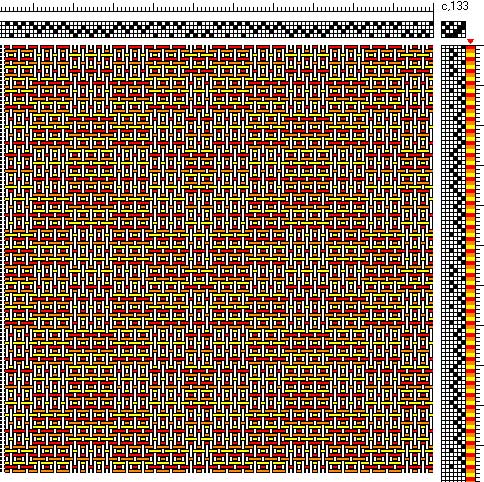
I have written about "weave structure language" before, here and here, so now I will only include five "very different" tieups.


Question of the week: are they different, really?


29/04/2014

April shuttle


This year, I forgot about the April spools day until way too late.

However, on the last week-end of April, all glassworks hereabouts open their new summer exhibitions - for some reason they always (?) choose not to show pictures... Anyway, we went to Kosta, where I found this:


It was just a detail in a biggish (3 x 3 m?) installation by Bertil Vallien (and I neglected to take an overview picture).
In the second picture you can clearly see that it once was a genuine hand shuttle. (Click to biggify)

Innovative? Or sad?

(Here are a couple more pictures from our "arty" trip on the Saturday.)

14/03/2014

International pi day

Let's first see if blogger accepts the pi sign - as it didn't, here is a picture of a pi sign:

I wanted to celebrate the day by making a drawdown showing such a sign, but it turns out that 16 shafts are not enough to make a nice pi.

However. Pi has an infinite number of decimals, so let me instead present an infinite number of (ok, just 8) ways to achieve a straight 2/2 twill, all with straight treadling.

First: a straight 2/2 twill on a 4-shaft broken threading:

Next, an 8-shaft, 12-treadle variant. (Why 12 treadles? - because the draft started out as a weft-emphasis plaited twill, which needed 12 treadles)

However, that many treadles are not needed - in fact, you only need 4. Any 4:

A 10-shaft variant. Could this be called a "broken point threading"? As before, only 4 treadles are needed.

Onwards we go... 16 shafts, with a couple of threadings I don't know why one would like to use:

As I actually have 20 treadles on my trusty CM - here is one that uses all of them:

So why the label "cultural differences"? Because it shows why some of us dumb Swedes do not understad the term "twill threading" so often used on the international forums... (I have writtten about it before - here is one example on this blog, here is an article on my website.)

09/05/2013

Some things never change, do they?


And – just to prove Laura is not the only one:


All this from here

03/05/2013

History looming...

A few pictures - Masson mill, near Matlock, founded by Richard Arkwright


In the weave shed, one whole wall was filled with saved threadings:


And who knows how old this sign is?

(I really, really need to learn the weaver's knot. Or maybe not?)

To show that we have some other interests, we are overnighting in Haworth (of Brontë fame). But I see more textiles in our near future...

02/04/2012

more spool me

As ususal, I marvel at the cultural differences possible in the smallest details. Yesterday, I looked at all spool-pictures inspired by Meg, and I read about making spools out of paper: rolled round pens, taped, made just to take care of "qrumbs" (quill-thrums? sorry – I must be bored...)

As usual, what we all learned from the beginning tends to be the "correct" way – so let me present: the correct way to make weft-packages ;-)

First, take a paper (this is a test print for hang tags for cushions, with some obsolete notes. Almost any paper works, except flimsy newsprint - unless desperate, then take 2 pages of flimsy newsprint). Fold it three times, for an 8-fold thickness.


Cut out an oval (well, 8 ovals). Remember to use the scissors for paper!


Now I am done. Easy, yes?


To use a new quill: the first time, lick on a “corner” before taking it to the winder. The moisture helps to get it snug on the shaft.


When the paper is almost wound on, add the yarn.


and wind on:


When the quill is empty, it looks like this


and can be re-wound, or put in the box for next time it is needed. (It may need licking a few times more)
Warning: do not inset the yarn until at least half of the paper is on the shaft, or it can come out and wind on the spindle, which is bad for weaving...

And, now that I have the pictures – here is my quill box


(Unfortunately, I dropped a shuttle and cracked the glass, but it still holds out most of the dust)

21/02/2012

Crackle – corrections

Thanks to Laura, I now have re-read the Tidball book.
What I remembered was wrong (or came from another book altogether).

Tidball does indeed advocate three colours, but in a way different than I thought:
(easier to scan than to type it...)

A bit later she also writes that she uses "a heavy dark and two fine light colors".

So let’s go back some. Here is the profile, again:

Here it is, the threading again converted according to Tidball’s system. I don’t know what she means with “follow the rythm”, but this is a guess.


Using Tidball’s treadling system (as above – assuming that "block A" is the leftmost), and the recommendations to use one dark heavy weft and two fine light wefts, it looks like this:


(Again, I rotated to make it bigger in the picture-wiever)
Note that, according to the treadling specifications, there is one extra light-coloured pick "for the transition", which means there are two same-coloured picks at the block changes.
(But why the two light colours?)

For truth’s sake, I should also quote another sentence: "Weaving as drawn in is not commonly attemped in crackle, though the Swedish books contain many crackle (called Jämtlandsvaev) drafts for elaborate symmetrical patterns, symmetrically woven." (Me, the dumb Swede, can’t se any obvious relation between symmetric draft, symmetrically woven, and "as drawn in"... And I still haven’t seen any Swedish jämtlandsdräll woven any other way than "as overshot".)

However. Several of the (north american) weaving softwares often want to use tromp-as-writ, if left to their “automatic” preferences. So the mystery still remains: why tromp-as-writ?

08/01/2012

Jämtlandsdräll (not-quite-crackle)

Alison gave me an idea - what if the (obviously quite often) missing treadlings in Swedish pattern books gave Davison the idea to "always" use tromp-as-writ?
(I leafed through Davison, and don't think she really does that "incorrectly" very often)

But: whence came the idea of tromp-as-literally-writ for jämtlandsdräll?

Now I have a theory: many (Swedish) books tell you something like: (usually after an explanation of how to determine the tie-up) "the treadling proceeds according to the profile threading" (trampningen följer partisolvningen)..
So, if you are not good at reading Swedish, this may look almost like "treadle as threaded" - with the little difference that we (Swedes) read it as, well, profile threading.

For jämtlandsdräll, determining the tie-up can be somewhat trícky. Below is my attempt to translate from Varp och inslag (ISBN 91-27-35226-9 B):
"   Tie-up:
Two shafts will be tied to each pattern treadle.
If two blocks weave pattern at the same time, tie the shafts that are common to both blocks. Ie: block 1 is threaded on shafts 1,2 and 4, block 2 on shafts2, 3 and 1. Shafts 1 and 2 are common to both blocks, and are tied to one pattern treadle.
If one block weaves pattern [where the others do not], then tie two shafts that do not give pattern in other blocks. Block 1, for instance, can be tied two ways: either shafts 1 and 2, or shafts 1 and 4.
If the pattern contains both "single-pattern" and "double-pattern" blocks it is easiest to start with the "double-pattern" blocks.   "
(Probably not the best of translations, but...)

After experimenting with a very typical jämtlandsdräll profile, making substitutions according to (slightly) different rules, this is what I have got:


Substituting it "our" way, we get this:


As you can see, the pattern treadling follows the profile treadling, with tabbies in between. (Of course, in this instance, the profile treadling does not follow the profile threading)

Using that same threading, but woven-as-literally-drawn-in, we get:


We will never get the correct pattern - (ie the pattern the profile shows) because the treadling order should be different.

Letting PCW do the block substitution (and then fixing the tie-up - jämtlandsdräll tie-ups should always "be determined" os of above):


But - isn't this another variant of the pattern?
Making it two repeats (and turning the picture, hoping for better visiblity in blogger's new picture-handler) shows that it is indeed so:


Letting PCW do the substitution in "twill form" gets us something very like the original profile (after fixing the tie-up, of course). The differences there are can probably be "massaged out". The reason is that this follows the original profile treadling.


(I extended the pattern repeat to two, in most figures, to get a better wiev of the overall pattern. In other pictures there is one repeat plus one block to balance.)

So, getting back to the original question - whence came the idea of tromp-as-literally-writ for jämtlandsdräll? Why are we not to follow the profile?

And, even curiouser: from where did (Tidball, I think - read it in an American book anyway) the idea of a tree-colour rotation come? (I don't remember if something was said about colour values, so I just used red-orange-yellow):


But then, on the other hand, as Atwater writes (link goes to the document on handweaving.net):
so - who am I to tell what is right or wrong...

(ETA: seems I "fooled" the picture viewer: all pics become reasonably big if clicked, even the turned one!)

13/10/2011

London: some cultural observations

The view from my hotel room:


The hotel shall remain nameless, but the price was right...

This time I ventured into (by me) unchartered territory, which meant I had to occasionally consult the map. So... on which (obviously big) road was I? All the crossing (small and narrow) roads had signs - but the big did not. It appears that thoroughfares generally are signed at both ends, but not in the middle. Quite confusing, if one comes up from the underground, in the middle of the (long) road.
Common sights:


Not very common sight:


Also, there are often no numbers on the houses. Thus, I was looking for the Textile and Fashion museum. I walked, and walked, and walked... until I gave up and found a place to ask (it was Sunday). It turned out that I was about 100 numbers past. I turned around, and suddenly I was at #60 (I wanted 83). Turned again. I finally found a small(ish) door, with a small(ish) print (maybe all of 1" high) saying Textile and fashion museum... closed on Sundays (and Mondays).

Well, the weather was nice, so I went to Tate modern instead. The spoor of the (in)famous crack can still be seen:


(and to continue the tradition - here is a small water spout, Tate model:)


Later that afternoon - a sight to be seen only in London?


As it is such a good idea, they can have a link, too: pedibus.