Showing posts with label colour. Show all posts

30/04/2016

A mystery cloth


This is a top of my mother's:


She made it ages (20? 30?) years ago, from a remnant. Assumed cotton, but who knows, these days? It has a lovely hand.
I have always liked it, and always thought, carelessly, that it must be some kind of crackle-ish structure (although, who would have thought industry would make crackle-ish fabric for yardage?).

So, getting one step nearer:


Hm. Compare front and back ('cos this fabric has distinctly different faces).
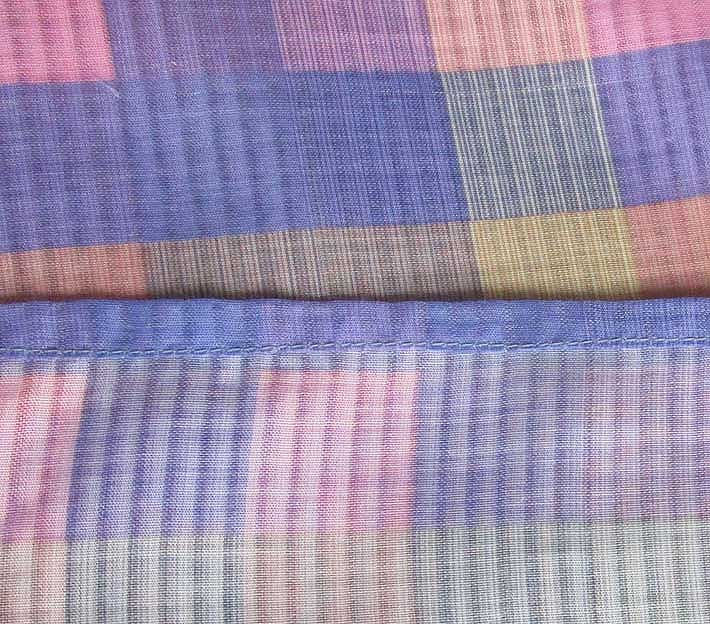

Hm. Face side again:


It certainly looks like plain weave, with a pattern of crammed-and-spaced warps... except is does have blocks of some sort?

Hm. Double hm. We can (sort of) see that the warp colours appear to change when the (weft) blocks change.
Or, that's what I think - 'cept I can't understand how, as the whole shebang still looks like plain weave... and the back doesn't really show any weft "blocks"?

The fabric can have been rotated, of course: white warp, coloured weft.
How many colours in the weft, then? (How many wefts can a modern loom handle? And it also has to handle the crammed-and-spaced effect.) And why weave something so complicated, when a multi-coloured warp and constant # of picks per cm would be so much easier? - could it be because this particular mill just had got this very ultra-modern loom, capable of handling a gazillion of wefts and varying the beating-up force - a kind of "because I could"-result?

Against the light (and now all pics start to be blurry... try holding a piece of almost see-through fabric I one hand, while trying to get your camera to focus with the other hand, and you'll see what I mean. First pic to illustrate my point... :-)


And in the last picture it looks like the cramming shifts... regardless of if in the warp or weft direction, HOW??? (click pics to biggify)

Well.

I still think it looks like plain weave, crammed-and-spaced, except it appears impossible to achieve the warp-stripe-colour-changes (that are, I think, essential to the overall colour block idea) with such a simple structure...

The warp colour-"changes" might be some colour-and-weave thing, with the warp being end-by-end... except that to make the "other" colour get to the surface - wouldn't that need a more complex structure?

Insights?

EDIT: for those guessing at some kind of leno - no, I thought about that. Unfortunately the photos aren't sharp 'nuf to blow up more - .

23/03/2015

Finally started!


Today I re-tied and started weaving.
But for some reason treadle 4 felt very strange... as if it was somehow blocked. As if, in fact, I had a treadle tied up to both lift and sink one shaft.

But... but I had woven ok, and the only thing that happened after that was the cutting off.

Checked the ties. They were ok, as they should.

The treadle still did not work properly.

Re-checked the ties. They still were ok.

Scratched my head, had some coffee, read a bit, had some more coffee.

Decided it was a fixable problem, if only I figured it out. Took a deep breath and went under the loom again. And found that the tie from shaft 1 to the upper lamm had tangled with the tie from shaft 2.
Thus I had wasted the best part of an hour trying to fix something I should have spotted in five minutes, max.

The final weft choice: cotton 16/2 in a soft beige, kind of oatmeal - not quite as it looks in the picture below:

13/12/2012

To paddle or not to paddle?

Why, I have been asked, do I not use a paddle when warping with multiple ends?

The question came as a comment to this post – and the shortest possible answer is: but I did – only the "paddle" took the form of a reed.

One longer answer is: because I often use several colours/nuances, and rarely want a 1/1 lease because that would prevent a "random" colour placement.
Examples of "random" colour threadings (and the results) are:


On the occasions I do want a "perfect" colour order and the ends are of similar value (and thus can be difficult to see when threading) I do make a 1/1 lease – but as these colour orders often do not repeat, I haven’t found a way to make the paddle work: once the ends are in the paddle, they have their set place... Also, my favourite method for making colour transitions is based on Pascal’s triangle, which means I need to change the number of ends I warp with all the time. The system is described in an article on my website – here.

Some examples:


Detail from side panel:

Another one:

Detail, approximately bottom left corner:

I have seldom had problems with bigger leases, probably because my loom(s) are quite long, and because I seldom use very fine threads. (Most of what I weave is cotton 30/2 and coarser, and my favourite wool is approx 10000 m/kg, or something over 5000 ypp.) Maybe I would find out the need for a 1/1 lease if I ever could get my hands on some real angel hair... :-)

23/07/2012

Gla’hål och vävfall

Or: "happy-hole" and "weave fall" - . Gla’hål is what it is called (in Swedish) when you can see the warp beam. Traditionally this is cause for a special coffee pause, but as I drink coffee all the time anyway, and don’t like sweets, I just went on to the next part of the weaving: testing all kinds of unlikely colour combinations.


The dark olive combined with the light green gave a quite nice result, I think. (Nothing is finished before it’s wet finished, and that goes for samples, too!)

Vävfall is the cut-off time (goes with another special coffee, traditionally). I cut off 4 double scarves, all slightly different (with another mug of plain coffee):


Here is part of the colour, hm, "gamp"?


Now I only have to make the fringes, wet finish and mangle...

27/06/2012

On colour gamps

From time to time the topic of colour gamps crops up.

Ages ago (before the age of digital cameras, anyway) I wove one a little different. I meant to keep it for myself, but one day someone wanted to buy it... and, what can I say: I am in this for the money (yeah right!), so of course I sold it.

Now, of course, I can’t remember exactly what/how I did. There were some old notes, but not in enough detail. (Something that never has happened to me before – I wish ;-)

I do remember it was about optic blending, and I do remember I tried to use the CMYK (Cyan-Magenta-Yellow) system, using what yarns I had on hand.

After some fiddling, this is what I think I did:
(click to make bigger – the bigger the more stripey it looks)


Here and there there are a few colour-and-weave patterns, if you look closely enough. Here is one portion:


In 2/2 twill:


which also shows some colour-and-weave patterns:


27/11/2011

Double the fun?

When reading Andrew's musings about double layers and colour, I remembered some ideas I had many years ago. I think I did weave samples, but I can't find them - so maybe I never did?

Anyway, as you may have noticed, I like playing with colour... :) The basic idea was to have two separate layers, one colour per layer, and then slowly changing the appearence of the colours, and in the end getting the the opposite.

So I started to play.... here are some ideas:

These are threaded on 8 shafts, with every other end blue, the other red. The weft order is the same, but, as the weaving progresses, the wefts not always alternate in the layers.
Both start with bringing one end of the other colour to the top, then one pick, next part takes 2 ends to the top etc. Which ends/pick are brought up differs in the two examples. (And yes, I think it would be better with less contrast - gold and yellow, perhaps?) - click to enlarge:


Another approach: here, just the warps that change place - threaded on 16 shafts.
To the left (but needs, obviously, some more work) "going both ways", to the right are both faces of the first half.

(The left needed a lot more contrast to even show at this size...)

Hmmm - perhaps: two warp colours, but only one weft? Would make it a tube, of sorts - but that would, perhaps, make it more useable? Hmm... perhaps I should try it IRW (In Real Weave) too?

18/09/2011

The importance of being colourful?

In response to Laura's post on Yarn (which sounds like an interesting book, but...):
Many years ago, there was a short story published in either SS&D or Handwoven. It was a delightful story, and it went something like this:

Once upon a time there was a little village. The inhabitants were dour and depressed (maybe depressing? ;-), life in the village was a drag, the children were listless... even the dogs were unhappy. Everyone was dressed in black, grey, drab colours all.
Then the village weaver died, and the villagers set out to find a new one. They found two young brothers who accepted the job.
The brothers arrived, and unloaded lots of colourful yarn and cloth. Nobody wanted to buy their cloth, because clothing should be drab, as it always had been. After a while they persuaded a mother to get something colourful for her child - and the child soon started to laugh and play. Slowly, slowly they persuaded the other villagers to try colours.
It took some time, but then the village (and its life) was totally transformed - people were happy, life was not half as dour as it had been before, there was play and laughter everywhere.

... just a thought, now that darkness and cold is before us... Some re-used pictures:


10/09/2011

Woollens

Always the sucker for nice woollen fabrics, I bought another (used) tweed jacket today.

Very ordinary cut, with some nice details. I can't decide if I like the buttons or not -


Approximately 7-8 ends and picks per cm; woollen singles.
Provenience unknown (no label).

08/02/2011

About rules, written and un-

Many years ago I went to Svensk Hemslöjd to ask if they would like to sell my scarves/shawls.
They did not, for two reasons: 1. I used colours (colours, not dyes!) that did not "exist in nature" and 2. they were not brushed, which made them "feel like fabric".

(I have a problem, here - can some native speaker pls help? "Fabric", above: she meant they felt like material used to sew garmants. What is the most correct word to use for this?)

The shawls I had brought were woven of the most soft and nice worsted (2/2/32 worsted count, spun in Scotland - I still have some of the yarn, but the labels are long gone), had a lace pattern that I also don't know in English (see below), but that Cyrus translates as "mosquito netting", and were (of course!) not brushed.
I had a couple of colour "lines" - I remember one warp was from several shades of burnt orange, with a different orange weft for each - another was turquoise (again several shades). I believe there were two more colur combos - all long gone, no pictures, but this was the idea:


Not even then I was naive enough not to know that there were unwritten rules for what would pass as "hemslöjd", but I had never thought the choice of colour would be one of them. After all, I had used a traditional Swedish weave structure, a traditional, um, "layout" (ordinary straight shawl, with traditional fringes, "ordinary" length and width). And to my mind, they were not "fabric", as they were far too open to sew with...

But - some people never learn... A couple of years later, I came back with different shawls. This time I had some V-shawls, and some I had sewn into a moebius shape. (This wasn't one of them - this was the sample. It is a lot "worse for wear", but it must be over 20 years old now)


In the moebiuses (??) I had experimented with warp face -> even-sided -> weft face structures, for a) more visual interest than plain weave or 2/2 twill and b) to make the join visually seamless. Something along these lines (though I believe it was slightly more complex):


Yes. Or, rather, no. These were not "traditional", so: no thanks.

That was the last time I tried to sell anything through Hemslöjden.

(- I have sold many Moebiuses over the years. It is a very good shape: with the right length it can be worn several ways, according to temperature: One turn over the head and the second turn around the neck; two turns around the neck; when you get warm, use only one turn and you get cooler without risking to drop it. Or it can be hung as a sash - over one shoulder and diagonally down to the waist.)

The next time I had problems with unwritten rules was when I decided to enter a flax spinning contest.
It appeared as if there were no rules - on asking, I was told "there are so many points to consider". After I had won, one of the judges told me that, "properly", I should not have - but the nominal winner had used a spinning wheel that was not traditional. (She had a Louet, with a big orifice, and everybody "knows" it is
"impossible" to spin fine on one of those - thus, her result was a pure fluke. I had an antique Swedish wheel.)
Several years later, after moving down here, I entered another flax spinning contest. The idea, said the invitation/rule sheet, was to educate the public. Good, I thought - looking forward to some kind of open judging, or at least some explanation afterwards. It would be nice to know what constitutes a good linen yarn.
But... not. Even though I came second, I still don't know what flax spinning judges look for in a spinning contest, or a linen yarn. On asking, I was told that I should be happy I had got good points.
(Having a background including dressage riding, I know it it perfectly possible to have judging protocols broken down into several smaller steps, with the possibility for judges to write comments. Which they often do.)

Now, we have the Handwoven/Väv Garment Challenge. Apparently, if one asks Handwoven, one will be told that weaves of more than 8 shafts will not be considered. Note: I have NO problem with that! But: why is this not in the rules?!? Considering the rules already are almost two screens long, one line more would not make that much of a difference.

22/11/2010

First of the "leaves"

I was thinking raindrops, but changed my mind and settled for leaf shapes.

I don't know if it qualifies as a "networked" design, so perhaps I should instead describe it as an "irregular dräll"?


For the first one I chose a green (with some blue in it) weft, which I thought would have enough contrast - but...:


The result can be called "subtle", I suppose. It is hopeless to try to photograph things in (what feels to be) total darkness of November, but the leaf-shapes show up better on the striped side than on the green - interesting, or perhaps strange? After all, the colours are exactly the same om both sides...

Even though I was confident about sett (10 ends per cm, cotton 16/2), I decided to cut off and finish the first before I wove on.
Then, of course, I wasn't patient enough to wait for the washing machine - . 


When done and pressed it had a nice hand, so that was ok - especially as I had woven almost half of the next by then..
Blue weft:


...perhaps I should use the blindning orange weft for the third...

11/11/2010

The rest of the ruffles

The double warp(s) are now done -


It never ceases to surprise me, the very very different results one gets just by using different wefts! The dark warp has 4 different blues (in 3 different grists), a brown wool stripe in two slightly different nuances, and the purple has 3 different nuances in 2 different grists.
The three different wefts I used:


The bobbin is silk noil, the other two are cotton 16/2 (the red looks browner when alone).
The red-brown gave, as can perhaps be seen (click for larger), even some iridescence in the blue part.

I have opened the sett successively over the years. When I went to weaving school the recommended sett for cotton 16/2 was 15-16 ends per cm for tabby - in these ruffled scarves I am down to 8, and get a stable fabric.   (Well - for scarves!)


On the other hand, reading old weaving books, they never wove cotton scarves... They wove things that had to be sturdy, like bedsheets, for example.
For suppler fabrics they instead went to finer yarns - cotton 30/2 is not uncommon for towels, tablecloths, drapes...
Reading for instance Engeström: Praktisk vävbok (first published 1896), we get recommended a cotton 20/2 at 16 ends per cm for twill - she says it will yield a good quality for kitchen towels, if woven with a "coarser linen or tow weft". For a finer weft, she says, one should go slightly closer.
She has a "dress fabric" (mostly tabby) in cotton 40/2, sett at 24 ends/cm.

If only there were such yarns to be had...

I have looked at our biggest yarn companies here in Sweden - one of them does not offer any cotton finer than 16/2, the next has 63 colours of 16/2, 14 colours of 24/2, all of to 25 colours 30/2, while the third offers 74 colours of 16/2, 56 colours of 20/2 but finer only unbleached.