Showing posts with label weave names. Show all posts
02/05/2015
The Falkirk tartan
or: what excessive googling can lead to...
Someone asked me about "the Falkirk tartan", could I help explain?
I had to admit that "the Falkirk tartan" wasn't in my cache memory, so I would have to get back later.
There were a gazillion hits on "Falkirk tartan". Here is a picture, snagged from the National Museum of Scotland enlarged to double size (click to maximize):
Some manipulating later, I decided this was as "improved" I could get it:
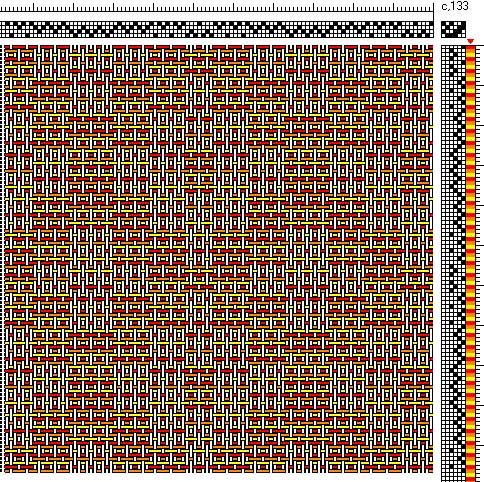
So, obviously, this is a straightforward 2/2 broken-reversed twill, treadled straight. (Well, who knows which direction is which, and it probably was neither "threaded" nor "treadled" as we understand the words nowadays, but the structure looks like this)
(edited to show the correct picture here)
However, several hits used this same sentence to describe it:
" Although small, it is of a type known as weft-woven (or dog-tooth) check in woollen fabric. It has a simple check design of natural light and dark wool."
Er, yes. Of course it is a weft-woven check (I mean, all cloth is woven with a weft, yes?). But just how often do we come across the combination weft (hyphen) woven? By then, my google-fu had deserted me, I just could not convince it to search for "weft-woven" (as in weft-hyphen-woven). Tried some other search engines, with the same result.
So: is there anybody out there who can tell me what exactly "a type known as weft-woven (or dog-tooth) check" means???
Giving up on that one, I went on to "dog-tooth". Maybe I shouldn't have done that... as usual, "trade" has its own definitions, sometimes not agreeing with "handweaver" defs.
According to my usual (handweaving) sources, hound's tooth is a colour-and-weave pattern, a 2/2 straight twill with 4-and-4-ends/picks. If the twill is broken/reversed, it can become a shepherd's check (but by now I have run out of stamina, and I can't remember which of the other three quadrants is what I think of as shepherd's check, and, besides, does it really matter?)
Labels:
colour-and-weave,
twill,
weave construction,
weave names
08/02/2015
Swedish weaving books, a list
... and some commentary, now on my website: here for English, here for Swedish.
If you see something wrong, or disagree with me, please send an e-mail (link on the page)
I have also some older texts for download (they are all on the page, but in the middle of the text) - collected here (English version, but there is a "button" at the upper left for toggling between languages. In fact, the button is there, same position, on all my web pages.)
To give this post some physical weaving content, here is a sample:
The warp is on the loom, the serial-to-usb works even for weaving proper, but the structure will be changed some.
Maybe the result will be called "the first daffodil".
(Sample above is hemmed but not wet finished. Once I saw the hemming idea worked, I was just interested in the float lengths vs how I think it will survive the "muggle" handling. Decided shorter are better.)
12/11/2014
Double damask?
Last year, when Laura and I were in Macclesfield, England, we saw a small piece of cloth described as "double-sided damask", also said to be "the same technique as used for cloth of gold". I had never heard of "double-sided damask" - to my mind, the nature of damask is to be double-sided. Jean gave me a tip: Murphy's "A Treatise on the Art of Weaving" (1824), but it is too complicated for me to understand. (Yes, I *have* tried several times :-) So I just dropped the problem, after all we have all seen strange labels in museums, yes?
However, yesterday someone posted a link to an article in NYT (or something), I went on from there and landed on the site of Thomas Ferguson Irish Linen - and they have a definition of "double damask" (link goes to the definition of "ordinary" damask, but both come up on the same screen).
I'm copying some of the text, and want discussion:
Linen damask is a figured fabric made from one warp and one weft in which, generally, warp-satin and weft-sateen weaves interchange. Twill or binding weaves are sometimes introduced.
I have no problems with this - sounds like "ordinary" damask, which incidentally is double-sided, or maybe I mean reversible.
But:
What is the difference between Linen Damask and Linen Double Damask?
Double damask is different from ordinary damask in that it has a lower warp thread count than weft thread count; this allows a dense high thread count fabric to be produced, as the weft yarns are beat up tight in the fabric. However, it is a much more expensive way of weaving because it takes longer to weave a given length of fabric. Also, to allow this dense packing of yarn a looser twill weave is used than in ordinary damask.
(there is some more text, but this will have to do for now. You can always use the link above)
So: ordinary damask is a warp-faced structure contrasted with the same structure, only weft-face, regardless of "thread count" or "balance" (same # of ends and picks) - but double damask is UN-balanced? And therefore better, because it has more picks than ends? And it is (always?) woven in twill? Because twill is a "looser weave" than satin? Huh?
Further down, they mention that they use finer yarns for the double damask, which gives better pattern definition. I am OK with that, of course finer yarn give better definition, but...
Another quote:
As stated earlier, to allow the dense packing of yarn, a looser twill weave is used when weaving double damask than in ordinary damask. This requires a high thread count to stabilise the fabric. With a low thread count this was not the case.
These poorly made fabrics were sub standard, and normal damask was in many instances a better buy. This forced the hand of the Irish Linen Guild and they brought in a minimum thread count for double damask.
(Unfortunately, the Irish Linen Guild does not tell what kind of counts they used for their definitions - at least I can't find them.)
Conclusion: still confused, perhaps more than before (when I could still blame the museum label).
Or: can it be another of these different culture, different language things again?
I sometimes discuss fabrics with my neighbour, the cloth merchant: he is a textile engineer, trained in industry. We can usually (but not always) agree on plain weave, but in industry there are (apparently) so many more parameters in
Sometimes they (he) use a structure name when they mean to include a lot more information: fibre content, weight...
And sometimes they use a structure name for something quite different: "cord" comes to mind. At least here I Sweden a "cord" in a fabric shop is what we weavers usually call "corduroy".
In the UK, a "corded silk" (at least in conjunction with academic dress) is typically a warp rep, very seldom woven of silk. (Yes, I have analysed a piece, and burnt it.)
Labels:
cultural differences,
fabric names,
weave names
02/04/2014
About dräll and other patterns
Starting with the word: dräll is a difficult word, probably coming from latin trilix, meaning three threads. (Note: in the etymology there is nothing at all that suggests "pattern".)
In Sweden, (the unqualified word) dräll has often been used as if meaning patterned (any kind of pattern). Sometimes, the word is qualified to "äkta dräll" (true dräll), when referring to a pattern where blocks of warp-faced structure contrasts with blocks of weft-faced (either turned twill or turned satin - thus multishaft).
As multishaft looms were not the most common, but the wish for patterning was, several methods for patterning on only 4 shafts were developed - as they were developed to mimic "true dräll" they often are referred to as "simplified drälls". Examples of simplified drälls are daldräll (overshot), jämtlandsdräll, sålldräll (Ms and Os, I think), kuvikas (S&W)... All of these have one principle in common: there is one warp system, but two weft systems, one of which gives plain weave.
There are many patterns named after a province (daldräll, jämtlandsdräll), a village (rovadräll, tynderödräll).
Other "meaningless" names are fattigmansdräll (poor (wo)man's dräll), soldatdräll (soldier's dräll). Another thing they all have in common is that the names do not really denote a specific technique...
There is also halv-dräll, which only has two blocks. There have been several "inventors" of that technique, one of whom was Wilhelmina Bergman. She published "Den lilla vävboken" about 1878, where she claims to be the "inventor" of a way to weave dräll on just 4 shafts (and she got a patent, valid for a number of years, 5, I think). This method is very much alike to what we call halvdräll today, with the difference that she did not use two different yarns for weft. (In fact, several old books do not) Over the years (the book was reprinted many, many times) she "invented" 4 ways to thread her... weave (she doesn't give it a name). Here is a screenshot of all four:
(The one in the lower left corner will not give a true plain weave, because the threading does not follow the "odd-even" rule)
At some point another "name" cropped up: five-shaft dräll (femskaftsdräll). These were obviously done on five shafts (with a special five-shaft pulley, pictured here - scroll down a bit), and were woven in some kind of lace weave. As I am notoriously hopeless with the "names" of lace weaves, I'll leave it there... (An example can be seen on my website, here - at the end of the article.)
There were also a couple of ways to add shafts, dräll pulleys or "two-tier pulleys" (lunor, in Swedish). I have written about both kinds here. These were (still are?) quite common, even though countermarche looms had begun to be used already in the 1840-ies.
EDITED TO ADD: there is now a special page on my website which deals with dräll pulleys: http://bergdalaspinnhus.com/artiklar/cb-looms2-e.html
Enjoy!
Labels:
block weave,
dräll,
weave construction,
weave names
27/06/2012
On "gamps" – the word
The thing with being a non-native speaker is that sometimes you don’t even reflect on strange words. "Gamp" is what it is called, even if I would have tried with "colour sampler" first
It seems to me that "sampler" (or just "sample") is any sample, but a "gamp" always is about colour. Am I wrong on that? Or can a "structure sampler" (like, for instance the draft here) also be a gamp?
Somewhere I’ve heard the explanation that it comes from Sarah Gamp, the Dickens character. Now I decided to try to look it up.
Dicitonaries of course gave nothing – there is no English word spelled "gamp", just so you know...
Next try: google.
I got lots of hits. ALL of them (ok, just the first 20 or so) told me that is is British slang for umbrella, named after Sarah Gamp (see above). Unless, of course, it means Good Automated Manufacturing Practice.
On Wikipedia, I found that Sarah (or Sairey) Gamp "habitually carries with her a battered black umbrella".
So, dear readers (especially the native speakers among you) – WHY does a BLACK (and battered) umbrella lend the name to a COLOUR, er, "gamp"?
18/06/2012
The structure of a shirt
Once again, I made a foray to the second-hand store, found a shirt.
The shirt itself is unremarkable, almost boring, but is feels VERY nice to the touch. Soft and thick, all cotton – I thought it could be seersucker. It will be very nice in the winter, I think.
When I looked closer, it wasn’t seersucker. (I should have known; it is too thick.)

This is an enlargement – this piece is about 2,5 cm (1") square.
Here is the draft (I think; even using a magnifier it is difficult to be quite sure):

The yarn looks like singles, and the sett is about 44 ends/cm.
If we were to "name" this structure, what would it be?
09/06/2012
”Fixing” floats, some thoughts
I got a question: about strategies to fix long floats, á propos my twill play (which also appeared as weave-of-the-month for June, 2010). (links open in new windows)
First: how long is a “long float”? I’d say it depends on several things – the yarn used (wool will adhere to itself, “felt”, if you will, during wet finishing/pressing; most cellulose yarns will not), the grist of the yarn used (the same float length in numbers will be a lot longer in measured length for a thick yarn than for a thin), the end use of the cloth (a long-ish float in a towel in constant use will probably catch more than the same float lenght in a, say, scarf, or in a tablecloth).
Looking at the 16-shaft "idea-draft" it has max floats of 5. For my green blankets, I (probably) used a sett of 6 ends per cm, which makes the 5-end float shorter than 1 cm. Then wet finished, even if not "felted", these floats get a) shorter by "just" shrinkage and b) somewhat felted, thus less "outstanding". They will probably not survive the cats – but then, nearly nothing survives an enthusiastic cat...
Using the draft for, say, napkins, I would probably choose a cotton 16/2 sett at ... say 20 ends per cm, which would make the floats 2.5 mm (or 1/10" – this one was easy even for us metrics). And I think that actual float length requires a very enthusiastic cat to get destroyed fast...
However, this doesn’t answer the generic question about strategies.
As "extra" floats occur at the points where the threading/treadling reverses, the only way to eliminate them is to eliminate the reversals.
Here we have three different threadings (marked by different warp/weft colours), treadled "as drawn in". The "true" squares are outlined in a garish green, just to make them easier to see (click to biggify).

The first two (short points and longer points – the longer I would call goose eye), with a 2/2 tieup will never give longer floats than 3. Usually this is not a problem – but if you wish to avoid that, the only 4-shaft remedy (I think) is to thread like at the far left: at the reversing point, skip one shaft and go from shaft 4 to 2; from shaft 1 to 3. (This also means there is no way of obtaining true tabby, because you are no longer following the "odd-even" rule.) Treadling in the same way, you get what I call diamond twill, which could also be called broken-reversed twill. (I think I have seen it called "crystal twill" in English, but I may be wrong.)
These breaks-reversals can be extended without problems, to get bigger diamonds – they can be treadled straight to give what I call herringbone. These threadings/treadlings never give floats longer than over 2 ends/picks.(again click to biggify)

21/02/2012
Crackle – corrections
Thanks to Laura, I now have re-read the Tidball book.
What I remembered was wrong (or came from another book altogether).
Tidball does indeed advocate three colours, but in a way different than I thought:
(easier to scan than to type it...)
A bit later she also writes that she uses "a heavy dark and two fine light colors".
So let’s go back some. Here is the profile, again:
Here it is, the threading again converted according to Tidball’s system. I don’t know what she means with “follow the rythm”, but this is a guess.
Using Tidball’s treadling system (as above – assuming that "block A" is the leftmost), and the recommendations to use one dark heavy weft and two fine light wefts, it looks like this:
(Again, I rotated to make it bigger in the picture-wiever)
Note that, according to the treadling specifications, there is one extra light-coloured pick "for the transition", which means there are two same-coloured picks at the block changes.
(But why the two light colours?)
For truth’s sake, I should also quote another sentence: "Weaving as drawn in is not commonly attemped in crackle, though the Swedish books contain many crackle (called Jämtlandsvaev) drafts for elaborate symmetrical patterns, symmetrically woven." (Me, the dumb Swede, can’t se any obvious relation between symmetric draft, symmetrically woven, and "as drawn in"... And I still haven’t seen any Swedish jämtlandsdräll woven any other way than "as overshot".)
However. Several of the (north american) weaving softwares often want to use tromp-as-writ, if left to their “automatic” preferences. So the mystery still remains: why tromp-as-writ?
09/01/2012
Weftfaced, with 3-colours
seems not to be the answer.
At least - what I (think I) remember about the 3-colour version was that the colours should always rotate the same, 1-2-3.
Laura suggested the 3-colur version was meant to be woven weft-faced.
I took the draft from yesterday and asked for a weft-faced representation:
Hmm - but we all know that shifting the colours can make big difference. Below left started with orange, then yellow, red - below right the order is red, orange, yellow.
Apparently it is not THE solution...
08/01/2012
Jämtlandsdräll (not-quite-crackle)
Alison gave me an idea - what if the (obviously quite often) missing treadlings in Swedish pattern books gave Davison the idea to "always" use tromp-as-writ?
(I leafed through Davison, and don't think she really does that "incorrectly" very often)
But: whence came the idea of tromp-as-literally-writ for jämtlandsdräll?
Now I have a theory: many (Swedish) books tell you something like: (usually after an explanation of how to determine the tie-up) "the treadling proceeds according to the profile threading" (trampningen följer partisolvningen)..
So, if you are not good at reading Swedish, this may look almost like "treadle as threaded" - with the little difference that we (Swedes) read it as, well, profile threading.
For jämtlandsdräll, determining the tie-up can be somewhat trícky. Below is my attempt to translate from Varp och inslag (ISBN 91-27-35226-9 B):
" Tie-up:
Two shafts will be tied to each pattern treadle.
If two blocks weave pattern at the same time, tie the shafts that are common to both blocks. Ie: block 1 is threaded on shafts 1,2 and 4, block 2 on shafts2, 3 and 1. Shafts 1 and 2 are common to both blocks, and are tied to one pattern treadle.
If one block weaves pattern [where the others do not], then tie two shafts that do not give pattern in other blocks. Block 1, for instance, can be tied two ways: either shafts 1 and 2, or shafts 1 and 4.
If the pattern contains both "single-pattern" and "double-pattern" blocks it is easiest to start with the "double-pattern" blocks. "
(Probably not the best of translations, but...)
After experimenting with a very typical jämtlandsdräll profile, making substitutions according to (slightly) different rules, this is what I have got:
Substituting it "our" way, we get this:
As you can see, the pattern treadling follows the profile treadling, with tabbies in between. (Of course, in this instance, the profile treadling does not follow the profile threading)
Using that same threading, but woven-as-literally-drawn-in, we get:
We will never get the correct pattern - (ie the pattern the profile shows) because the treadling order should be different.
Letting PCW do the block substitution (and then fixing the tie-up - jämtlandsdräll tie-ups should always "be determined" os of above):
But - isn't this another variant of the pattern?
Making it two repeats (and turning the picture, hoping for better visiblity in blogger's new picture-handler) shows that it is indeed so:
Letting PCW do the substitution in "twill form" gets us something very like the original profile (after fixing the tie-up, of course). The differences there are can probably be "massaged out". The reason is that this follows the original profile treadling.
(I extended the pattern repeat to two, in most figures, to get a better wiev of the overall pattern. In other pictures there is one repeat plus one block to balance.)
So, getting back to the original question - whence came the idea of tromp-as-literally-writ for jämtlandsdräll? Why are we not to follow the profile?
And, even curiouser: from where did (Tidball, I think - read it in an American book anyway) the idea of a tree-colour rotation come? (I don't remember if something was said about colour values, so I just used red-orange-yellow):
But then, on the other hand, as Atwater writes (link goes to the document on handweaving.net):
so - who am I to tell what is right or wrong...
(ETA: seems I "fooled" the picture viewer: all pics become reasonably big if clicked, even the turned one!)
Subscribe to:
Posts (Atom)