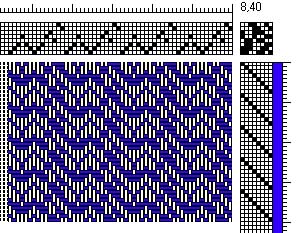
Can "goose-eye" be combined w other structures?
Well, not all of them... at least not if using 4 shafts.
Showing posts with label twill. Show all posts
29/11/2017
20/02/2017
"Alternative news" from Sweden
My very busy half-year is (hopefully) soon coming to an end: in October my mother (97) moved to a so called service apartment.
"Down-sizing", anyone?
I have been carting things here and there, to her new place and to me (and some to second-hand and the dump, too). But now I can see the end of all this – her old apartment is going on the market in a couple of weeks. (After I have taken one last load down here... - faamous lsat words?)
Last week I came home with a well-travelled suitcase, containing a jacket, an experimental moebius scarf (made by me) and some small yardage pieces (woven by her) – also some glass pieces for our growing museum, and some for re-homing.
(I really like how the back of the hood came out!)
Also, plans start to emerge for the Event of the Year: VÄV2017, this time at a place near me.
Oh yes – what happened in Bergdala, Sweden last Friday: grey/rainy weather with icy roads, the snowdrops got visible again after the rain, the assiettes got re-homed and the service workshop ordered a new part for my new computer. Even if the wind sometimes was hard, there were no earth-shaking events (but the aspen across the lane still looks like it will fall with the smallest gust of wind).
So there!
"Down-sizing", anyone?
I have been carting things here and there, to her new place and to me (and some to second-hand and the dump, too). But now I can see the end of all this – her old apartment is going on the market in a couple of weeks. (After I have taken one last load down here... - faamous lsat words?)
Last week I came home with a well-travelled suitcase, containing a jacket, an experimental moebius scarf (made by me) and some small yardage pieces (woven by her) – also some glass pieces for our growing museum, and some for re-homing.
(I really like how the back of the hood came out!)
Also, plans start to emerge for the Event of the Year: VÄV2017, this time at a place near me.
Oh yes – what happened in Bergdala, Sweden last Friday: grey/rainy weather with icy roads, the snowdrops got visible again after the rain, the assiettes got re-homed and the service workshop ordered a new part for my new computer. Even if the wind sometimes was hard, there were no earth-shaking events (but the aspen across the lane still looks like it will fall with the smallest gust of wind).
So there!
Labels:
block weave,
clothing,
curiosities,
dräll,
Moebius,
twill
07/09/2016
Dräll pulleys and opposite tie-ups, again
So is it possible to use dräll pulleys for other than two-block "opposite" weaves?
To refresh your memory, here is one illustration from my web page on dräll pulleys, with 6 shafts mounted:
The question came up in another context, and I tried to construct some examples.
Starting with a 2/2 twill - this is one "normal" way to thread and tie it up:
(The red line represents the position of the dräll pulley, the line which makes the mirror for the opposite tieup)
As can be seen, that tieup will not work. Starting from the left, the first column will work. The second will not, as shafts 1 and 4 both go up (in the Swe notation), while shafts 2 and 3 both go down). Third column is "opposite", fourth is not.
So what can be done? We need to do something to both column 2 and 4, trying to get them "opposite". One way is this:
By changing the threading, we have also changed the tieup, which is now compatible with the dräll pulleys: it is now "opposite". (Note that this also prevents a true tabby, as the threading no longer follows the odd-even rule).
Next try, an 8-shaft even tieup (by "even" I mean that all sheds have half of the shafts up, half down, in various combinations - see a discussion on "even" weaves here)
Started with the leftmost column - and got the fourth correct as a bonus.
However much I tried, I could not fix more than 4 columns/treadles.
Maybe I could modify the pattern some, and still like the result? So I marked all the ties that conformed with the rule:
Started to take out/put in ties in the possible positions... this was the best result I could come up with:
Would I weave this? No, but then, I am on a countermarche...
Compare it to my starting point:
I tried various other even tieups with much the same results, and in the end I decided that there is a good reason the pulleys are called "dräll" pulleys: they are excellent for two-block "opposite" structures! For all the others, there are countermarche looms...
Labels:
counterbalance looms,
dräll,
twill,
weave construction
30/03/2016
How can I live without floating selvedges?
was a question on a forum last week.
Easily, is the fastest answer. I had been weaving for 20+ years before I even heard about such animals... (and I confess: have not tried FS, not even once, since I heard about them. And, since it is confession time: once in a while I have been known to make an extra turn around the outer end - but I had done that for the 20+ years of weaving before I heard about FS, so I don't know if that counts)
So, how?
Here are some answers:
1. see what happens. IF an end doesn't get caught, ignore it.
2. IF an end doesn't get caught, and it annoys me (probably not, but anyway) - try starting the weft from the other side.
3. think about them before weaving (see below)
The thinking gets easier with written-out structure (binding) diagrams.
Like this: let us assume a 2/2 twill, thus 4 shafts. There are four possible permutations for the tie-up(s). Likewise, there are two possible ways (directions) for threading (/// or \\\). For treadlings there are, again, four possibilities: /// and \\\, but also if we treadle from the top down ("American way") or from the bottom up ("Swedish way").
Here goes: first diagram. The colours in the wefts are put there to distinguish between right-to-left and left-to-right (in reality they are the same colour, as this is a single-shuttle weave)
Going clockwise from upper right: treadling from top to bottom, from right to left (means the red wefts go from right to left): both outer ends get caught. Treadling from bottom to top (means the yellow wefts go from right to left): both outer ends get caught.
However: if one shifts the shuttling direction, both outer ends become un-bound.
Next quadrant (bottom right): exactly the same applies - shuttling from right to left both outer ends get caught. If switching shuttling direction, both outer ends get not-caught.
The two left-hand quadrants work the opposite: if shuttling from right to left, both outer ends get un-caught - reversing the shuttling direction lets the outer ends get caught.
(As I always want to start from the right, I crossed out the two left-hand quadrants)
Diagram 2 - the tie-up is shifted one step up.
As I always want to start from the right, I crossed out the two right-hand quadrants because the outer ends will be un-caught.
Diagram 3 - the tie-up shifted yet one step up.
As I always want to start from the right... the two left-hand quadrants are crossed out.
Diagram 4 - the last permutation in the tie-up.
As I always (etc)... the two right-hand quadrants are crossed out.
Of course, all of the crossed-out quadrants can be fixed by either:
- starting the shuttling from left to right
- OR (still shuttling my fave direction) by adding or subtracting one end each side.
OK, I hear you: BUT what about a more complicated binding (structure)?
This is a random structure that I found on handweaving.net:
As I always prefer to start from the right, AND (being Swedish) read the treadling from the bottom up: here the turquoise picks go from right to left.
With this threading, tie-up and treadlings there will be some un-caught outer ends. If I haven't made a mistake (or two...) the longest selvedge float will be seven picks.
Is seven picks too much?
Well - for a, say, rug (or other coarse weave): yes, definitely.
But for something woven at some 30-40-50 ends/picks per inch? Being metric, I don't much care for "inching", but a free end at the selvedge being 1/2 to 3/4 of a centimetre is nothing much to me.
(It, of course, also depends on the end use of the cloth: if it is to be cut and sewn, the selvedges do not matter at all (coarse cloth or not).)
So, adding to the three "answers" above:
1. see what happens. IF an end doesn't get caught, ignore it.
2. IF an end doesn't get caught, and it annoys me (probably not, but anyway) - try starting the weft from the other side.
3. think about them before weaving (see above)
4. what is the fabric meant to be used for? IF for cutting and sewing, then selvedges usually are of no importance
5. what are the actual lengths of the "free" selvedge threads? Is it likely to catch?
6. (if I am hand-throwing: maybe catch the selvedge "manually" now and again - at the "points" of the top treadling)
This, my friends, is how I live without floating selvedges!
(Re point treadlings, see this post , which mainly is about making a "clean cut" when changing treadling direction.)
Easily, is the fastest answer. I had been weaving for 20+ years before I even heard about such animals... (and I confess: have not tried FS, not even once, since I heard about them. And, since it is confession time: once in a while I have been known to make an extra turn around the outer end - but I had done that for the 20+ years of weaving before I heard about FS, so I don't know if that counts)
So, how?
Here are some answers:
1. see what happens. IF an end doesn't get caught, ignore it.
2. IF an end doesn't get caught, and it annoys me (probably not, but anyway) - try starting the weft from the other side.
3. think about them before weaving (see below)
The thinking gets easier with written-out structure (binding) diagrams.
Like this: let us assume a 2/2 twill, thus 4 shafts. There are four possible permutations for the tie-up(s). Likewise, there are two possible ways (directions) for threading (/// or \\\). For treadlings there are, again, four possibilities: /// and \\\, but also if we treadle from the top down ("American way") or from the bottom up ("Swedish way").
Here goes: first diagram. The colours in the wefts are put there to distinguish between right-to-left and left-to-right (in reality they are the same colour, as this is a single-shuttle weave)
Going clockwise from upper right: treadling from top to bottom, from right to left (means the red wefts go from right to left): both outer ends get caught. Treadling from bottom to top (means the yellow wefts go from right to left): both outer ends get caught.
However: if one shifts the shuttling direction, both outer ends become un-bound.
Next quadrant (bottom right): exactly the same applies - shuttling from right to left both outer ends get caught. If switching shuttling direction, both outer ends get not-caught.
The two left-hand quadrants work the opposite: if shuttling from right to left, both outer ends get un-caught - reversing the shuttling direction lets the outer ends get caught.
(As I always want to start from the right, I crossed out the two left-hand quadrants)
Diagram 2 - the tie-up is shifted one step up.
As I always want to start from the right, I crossed out the two right-hand quadrants because the outer ends will be un-caught.
Diagram 3 - the tie-up shifted yet one step up.
As I always want to start from the right... the two left-hand quadrants are crossed out.
Diagram 4 - the last permutation in the tie-up.
As I always (etc)... the two right-hand quadrants are crossed out.
Of course, all of the crossed-out quadrants can be fixed by either:
- starting the shuttling from left to right
- OR (still shuttling my fave direction) by adding or subtracting one end each side.
OK, I hear you: BUT what about a more complicated binding (structure)?
This is a random structure that I found on handweaving.net:
As I always prefer to start from the right, AND (being Swedish) read the treadling from the bottom up: here the turquoise picks go from right to left.
With this threading, tie-up and treadlings there will be some un-caught outer ends. If I haven't made a mistake (or two...) the longest selvedge float will be seven picks.
Is seven picks too much?
Well - for a, say, rug (or other coarse weave): yes, definitely.
But for something woven at some 30-40-50 ends/picks per inch? Being metric, I don't much care for "inching", but a free end at the selvedge being 1/2 to 3/4 of a centimetre is nothing much to me.
(It, of course, also depends on the end use of the cloth: if it is to be cut and sewn, the selvedges do not matter at all (coarse cloth or not).)
So, adding to the three "answers" above:
1. see what happens. IF an end doesn't get caught, ignore it.
2. IF an end doesn't get caught, and it annoys me (probably not, but anyway) - try starting the weft from the other side.
3. think about them before weaving (see above)
4. what is the fabric meant to be used for? IF for cutting and sewing, then selvedges usually are of no importance
5. what are the actual lengths of the "free" selvedge threads? Is it likely to catch?
6. (if I am hand-throwing: maybe catch the selvedge "manually" now and again - at the "points" of the top treadling)
This, my friends, is how I live without floating selvedges!
(Re point treadlings, see this post , which mainly is about making a "clean cut" when changing treadling direction.)
02/05/2015
The Falkirk tartan
or: what excessive googling can lead to...
Someone asked me about "the Falkirk tartan", could I help explain?
I had to admit that "the Falkirk tartan" wasn't in my cache memory, so I would have to get back later.
There were a gazillion hits on "Falkirk tartan". Here is a picture, snagged from the National Museum of Scotland enlarged to double size (click to maximize):
Some manipulating later, I decided this was as "improved" I could get it:
So, obviously, this is a straightforward 2/2 broken-reversed twill, treadled straight. (Well, who knows which direction is which, and it probably was neither "threaded" nor "treadled" as we understand the words nowadays, but the structure looks like this)
(edited to show the correct picture here)
However, several hits used this same sentence to describe it:
" Although small, it is of a type known as weft-woven (or dog-tooth) check in woollen fabric. It has a simple check design of natural light and dark wool."
Er, yes. Of course it is a weft-woven check (I mean, all cloth is woven with a weft, yes?). But just how often do we come across the combination weft (hyphen) woven? By then, my google-fu had deserted me, I just could not convince it to search for "weft-woven" (as in weft-hyphen-woven). Tried some other search engines, with the same result.
So: is there anybody out there who can tell me what exactly "a type known as weft-woven (or dog-tooth) check" means???
Giving up on that one, I went on to "dog-tooth". Maybe I shouldn't have done that... as usual, "trade" has its own definitions, sometimes not agreeing with "handweaver" defs.
According to my usual (handweaving) sources, hound's tooth is a colour-and-weave pattern, a 2/2 straight twill with 4-and-4-ends/picks. If the twill is broken/reversed, it can become a shepherd's check (but by now I have run out of stamina, and I can't remember which of the other three quadrants is what I think of as shepherd's check, and, besides, does it really matter?)
Labels:
colour-and-weave,
twill,
weave construction,
weave names
23/04/2015
Now what?
The fan fabric is done: inspected (several mistakes... some mis-sleying, some treadling mistakes, some must-have-been-a-bad-shed, one end not caught for long stretches), some repairs (only broken ends, the mistakes were too difficult); washed; mangled.
(I'm hoping I can get at least one shirt without glaring mistakes - perhaps it was A Good Thing I used such a busy/uneven pattern?)
So what have I learned? I think the most important thing is not to sley three per dent, because 1) it is very difficult to get it correct and 2) all too often the three ends did not separate when crowded.
I would have used a temple, had I but planned better: just five centimetres wider, and my biggest temple would have worked. Or: just 10 cms narrower, and one of the shorter temples would have been enough.
I also have learned to look better at the yarns when doing fairly dense setts - some of the spools had twisted-together ends, when they might have been knotted for better strength. I might have seen the knots, but the twists just separated.
Perhaps also it would have been better with fewer shafts? The more shafts, the more difficult to optimize the sheds. Here I had 8 shafts, and after too much fiddling I decided the top of the sheds were "good enough"... wrong decision, obviously.
It was "interesting" to mangle a fan fabric. As you have seen, there are small bumps in the cloth when weaving. They are not all gone when washed, and even knowing the trick of only smoothing to the sides (never along the warp) when rolling, some bumps wanted to stay.
No matter how tight one tries to make the roll, after a couple of passes it has loosened - partly because of the back-and-forth motion of the mangle, partly because the cloth flattens. Because of the persistent bumps, I re-rolled several more times than I normally do. The result is ok, though.
(But I "cheated" and pressed after mangling, also to help with the after-drying...)
Some pics:
Now to decide what kind of shirt to make, to go with the sort-of-diagonal-ish pattern.
One of the obvious choices is a not-really-shaped top, but there are five metres of fabric...
Perhaps some kind of kimono (or do I mean bat-wing?) "over-shirt", perhaps? I'm not sure about set-in sleeves with a fabric like this - thinking that probably they have to be matched in some way.
For now, the fabric sits on a roll on top of the fabric shelves.
Labels:
cold mangling,
fan reed,
mangling,
temples,
twill
16/10/2014
Fanning for the future?
Before I had discussed fan-reed ideas with Pat, it had not even occurred to me to strive for straight edges. I mean - when you can do curvy, when in fact the whole idea is to make curves, why not do curvy edges as well? Oddly enough, Pat said the same, only opposite: fabric, whatever the use, should always have straight edges.
So I cooked up something radically different (from what I had tried previously): an advancing point threading with an advancing treadling - neither threading nor treadling "evening" with the reed:
To accomplish straight edges one has to sley from one "middle-of-the-fan" to another "middle-of-the-fan". With my reed that means the warp has to be offset a bit. As there are 26 dents/fan, and I sley double, I made the colour code on the draft above (click to biggify!):
from the right, from start to first red line, the 26 ends go in the half-fan; next fan gets 52 ends (to second red); from second red to first yellow, from first yellow to second; from second yellow to first green... I simply ended where I had the last half-fan filled.
The treadling repeat is 40 picks, I move the reed every 10 picks, and use 6 positions. This means the reed movements/treadle sequence do not coincide until after 8 complete reed movements.
Finally, I had found something that looks promising on the loom! In my experience, all fanned cloth looks streaky on loom - so did this:
After fringeing, wet-finishing including pressing and mangling, it looks like this:
Most (but not all) weft streaking evened out with wet finishing, and the edges are tolerably straight.
But something funny happened when it was still damp: I was pressing, and dragged it along the ironing board. Look what happened:
My first thought was that I had somehow "ruined" the straight edges, but it was just a passing phenomenon. When it was completely dry, it stopped doing that.
Someone suggested a fabric like this could be a nice yardage, for a jacket maybe.
I like the thought, but have no idea what yarn to choose.
The reed is a nominal 50/10cm, which means the most open part is somewhere 3-3,5 dents per cm, the closest end has about 12 dents per cm. For this piece I used cotton 16/2, and it is a bit too open in the open parts, I'm afraid it will easily snag.
But with a thicker yarn... how would that work in the close parts?
A yarn with more tooth, like linen, would perhaps work better structurally - but my first (ever) sample had linen warp. It got cut off after many, many mended ends and some 30 cm. Maybe it would work with linen weft only?
Or should I try wool? With a carefully monitored fulling?
22/03/2014
Looking at both sides
After the 2/2 twill adventure, I started to ponder even weaves.
What is an even weave?
To me it means that there are as many warps as there are wefts showing on top - very easy if we are talking straight threadings/treadlings (as in 2/2 twill, for example...) It seems like Emery (The primary structures of fabrics) is of the same opinion.
(Note: I am not thinking of sett/beat here; I'm not after a "balanced" weave, which for me means there are the same number of ends and picks.)
But what happens if we are using other threadings?
A simple point in both directions, can that really be "even"?
Counted over the whole repeat, there are 99 "up" ends and 97 "up" picks. Is that good enough to be called "even"?
Or a slightly fancier point - this one is even, with 56 ups each.
Treadled to a point, 102 ends, 94 picks.
Tromp as writ, we have 99 ends, 97 picks again.
Some fancier threadings:
This one comes out as even, too - again if counted over the whole repeat.
is also even.
So: how much can the ups and downs differ - can the simple diamond above be called "even"?
Or, perhaps: only straight weaves can be called "even"? (After all, many of the individual sheds above are not even)
I can't make up my mind - opinions welcome!
What is an even weave?
To me it means that there are as many warps as there are wefts showing on top - very easy if we are talking straight threadings/treadlings (as in 2/2 twill, for example...) It seems like Emery (The primary structures of fabrics) is of the same opinion.
(Note: I am not thinking of sett/beat here; I'm not after a "balanced" weave, which for me means there are the same number of ends and picks.)
But what happens if we are using other threadings?
A simple point in both directions, can that really be "even"?
Counted over the whole repeat, there are 99 "up" ends and 97 "up" picks. Is that good enough to be called "even"?
Or a slightly fancier point - this one is even, with 56 ups each.
Treadled to a point, 102 ends, 94 picks.
Tromp as writ, we have 99 ends, 97 picks again.
Some fancier threadings:
This one comes out as even, too - again if counted over the whole repeat.
is also even.
So: how much can the ups and downs differ - can the simple diamond above be called "even"?
Or, perhaps: only straight weaves can be called "even"? (After all, many of the individual sheds above are not even)
I can't make up my mind - opinions welcome!
14/03/2014
International pi day
Let's first see if blogger accepts the pi sign - as it didn't, here is a picture of a pi sign:
I wanted to celebrate the day by making a drawdown showing such a sign, but it turns out that 16 shafts are not enough to make a nice pi.
However. Pi has an infinite number of decimals, so let me instead present an infinite number of (ok, just 8) ways to achieve a straight 2/2 twill, all with straight treadling.
First: a straight 2/2 twill on a 4-shaft broken threading:
Next, an 8-shaft, 12-treadle variant. (Why 12 treadles? - because the draft started out as a weft-emphasis plaited twill, which needed 12 treadles)
However, that many treadles are not needed - in fact, you only need 4. Any 4:
A 10-shaft variant. Could this be called a "broken point threading"? As before, only 4 treadles are needed.
Onwards we go... 16 shafts, with a couple of threadings I don't know why one would like to use:
As I actually have 20 treadles on my trusty CM - here is one that uses all of them:
So why the label "cultural differences"? Because it shows why some of us dumb Swedes do not understad the term "twill threading" so often used on the international forums... (I have writtten about it before - here is one example on this blog, here is an article on my website.)
I wanted to celebrate the day by making a drawdown showing such a sign, but it turns out that 16 shafts are not enough to make a nice pi.
However. Pi has an infinite number of decimals, so let me instead present an infinite number of (ok, just 8) ways to achieve a straight 2/2 twill, all with straight treadling.
First: a straight 2/2 twill on a 4-shaft broken threading:
Next, an 8-shaft, 12-treadle variant. (Why 12 treadles? - because the draft started out as a weft-emphasis plaited twill, which needed 12 treadles)
However, that many treadles are not needed - in fact, you only need 4. Any 4:
A 10-shaft variant. Could this be called a "broken point threading"? As before, only 4 treadles are needed.
Onwards we go... 16 shafts, with a couple of threadings I don't know why one would like to use:
As I actually have 20 treadles on my trusty CM - here is one that uses all of them:
So why the label "cultural differences"? Because it shows why some of us dumb Swedes do not understad the term "twill threading" so often used on the international forums... (I have writtten about it before - here is one example on this blog, here is an article on my website.)
Labels:
cultural differences,
twill,
weave construction
Subscribe to:
Posts (Atom)