My very busy half-year is (hopefully) soon coming to an end: in October my mother (97) moved to a so called service apartment.
"Down-sizing", anyone?
I have been carting things here and there, to her new place and to me (and some to second-hand and the dump, too). But now I can see the end of all this – her old apartment is going on the market in a couple of weeks. (After I have taken one last load down here... - faamous lsat words?)
Last week I came home with a well-travelled suitcase, containing a jacket, an experimental moebius scarf (made by me) and some small yardage pieces (woven by her) – also some glass pieces for our growing museum, and some for re-homing.
(I really like how the back of the hood came out!)
Also, plans start to emerge for the Event of the Year: VÄV2017, this time at a place near me.
Oh yes – what happened in Bergdala, Sweden last Friday: grey/rainy weather with icy roads, the snowdrops got visible again after the rain, the assiettes got re-homed and the service workshop ordered a new part for my new computer. Even if the wind sometimes was hard, there were no earth-shaking events (but the aspen across the lane still looks like it will fall with the smallest gust of wind).
So there!
Showing posts with label dräll. Show all posts
20/02/2017
07/09/2016
Dräll pulleys and opposite tie-ups, again
So is it possible to use dräll pulleys for other than two-block "opposite" weaves?
To refresh your memory, here is one illustration from my web page on dräll pulleys, with 6 shafts mounted:
The question came up in another context, and I tried to construct some examples.
Starting with a 2/2 twill - this is one "normal" way to thread and tie it up:
(The red line represents the position of the dräll pulley, the line which makes the mirror for the opposite tieup)
As can be seen, that tieup will not work. Starting from the left, the first column will work. The second will not, as shafts 1 and 4 both go up (in the Swe notation), while shafts 2 and 3 both go down). Third column is "opposite", fourth is not.
So what can be done? We need to do something to both column 2 and 4, trying to get them "opposite". One way is this:
By changing the threading, we have also changed the tieup, which is now compatible with the dräll pulleys: it is now "opposite". (Note that this also prevents a true tabby, as the threading no longer follows the odd-even rule).
Next try, an 8-shaft even tieup (by "even" I mean that all sheds have half of the shafts up, half down, in various combinations - see a discussion on "even" weaves here)
Started with the leftmost column - and got the fourth correct as a bonus.
However much I tried, I could not fix more than 4 columns/treadles.
Maybe I could modify the pattern some, and still like the result? So I marked all the ties that conformed with the rule:
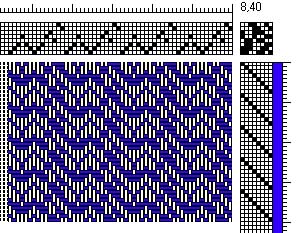
Started to take out/put in ties in the possible positions... this was the best result I could come up with:
Would I weave this? No, but then, I am on a countermarche...
Compare it to my starting point:
I tried various other even tieups with much the same results, and in the end I decided that there is a good reason the pulleys are called "dräll" pulleys: they are excellent for two-block "opposite" structures! For all the others, there are countermarche looms...
Labels:
counterbalance looms,
dräll,
twill,
weave construction
05/07/2016
Busy, but (still) not weaving
What with going up and down to Town (aka Stockholm) a lot, and getting the Glass museum ready for the tourist season, I haven't had much time for textiles.
(but the Glass museum site is now "on par" - ie all pages exist in both Swedish and English - and there is a g**le translate option both on the website and on the blog - feel free to visit!)
(EDIT: I just checked the translation of today's blog post... ACKKK! g**le translate isn't very helpful when it comes to oddities... is there a way I can convince you that it IS intelligible in Swe?!?)
However, this morning I found this:
which shows that that (the not-weaving) is not necessarily a problem...
(a few comments:
- "damastduk"? ok, so it says "paper" in a sort-of-backwards way, but... How will non-textile-y ppl understand what a damask (table)cloth can be, in some years time?
- "damast"? the pattern (not visible in the picture) shows a typical 4-block (possibly only 2-block... didn't open the package) true dräll* - for Swe weavers, damask is a considerably more complex pattern, usually achieved with the help of a drawloom...)
* "about dräll and other patterns"
(but the Glass museum site is now "on par" - ie all pages exist in both Swedish and English - and there is a g**le translate option both on the website and on the blog - feel free to visit!)
(EDIT: I just checked the translation of today's blog post... ACKKK! g**le translate isn't very helpful when it comes to oddities... is there a way I can convince you that it IS intelligible in Swe?!?)
However, this morning I found this:
which shows that that (the not-weaving) is not necessarily a problem...
(a few comments:
- "damastduk"? ok, so it says "paper" in a sort-of-backwards way, but... How will non-textile-y ppl understand what a damask (table)cloth can be, in some years time?
- "damast"? the pattern (not visible in the picture) shows a typical 4-block (possibly only 2-block... didn't open the package) true dräll* - for Swe weavers, damask is a considerably more complex pattern, usually achieved with the help of a drawloom...)
* "about dräll and other patterns"
Labels:
cultural differences,
curiosities,
dräll,
drawlooms
07/12/2015
Tablecloth for x-mas?
It has been a long time - I have tried to get this blog going again, but haven't had anything interesting to share... because I have buried myself in something entirely different (but maybe equally nerdy), namely how industrial glass etching was done at the turn of the last century. (Everything about that adventure at another blog, which is only in Swedish. And, because of many specialized words, I don't dare put a translator on it...)
Anyway. Remember this? I visited the same place today, and saw a tablecloth:
(warp runs right-to-left in the above picture)
I took some pictures, which unfortunately did not come out quite focussed. (Have a new camera, too - it likes to do things on its own, and I haven't been able to tame it yet.)
Here is one not too blurry closeup of the actual cloth (warp top-to-bottom):
Cotton in white and red, turned satin (more than 5-end, I think), and too many blocks (at least five, maybe 6).
This is not quite right, proportions are somewhat off, border very much cropped. I used a light yellow for the white weft, and an orangey red for the red weft.
Here is the five-block version:
Revised to make four blocks only:
With four blocks and changing the satin to 4-end twill, it can be woven on 16 shafts. (How to do that? One way is described in an article on my website, here - for Swedish, here.
(Of course this profile can be made into something completely different... daldräll, some lace... )
Anyway. Remember this? I visited the same place today, and saw a tablecloth:
(warp runs right-to-left in the above picture)
I took some pictures, which unfortunately did not come out quite focussed. (Have a new camera, too - it likes to do things on its own, and I haven't been able to tame it yet.)
Here is one not too blurry closeup of the actual cloth (warp top-to-bottom):
Cotton in white and red, turned satin (more than 5-end, I think), and too many blocks (at least five, maybe 6).
This is not quite right, proportions are somewhat off, border very much cropped. I used a light yellow for the white weft, and an orangey red for the red weft.
Here is the five-block version:
Revised to make four blocks only:
With four blocks and changing the satin to 4-end twill, it can be woven on 16 shafts. (How to do that? One way is described in an article on my website, here - for Swedish, here.
(Of course this profile can be made into something completely different... daldräll, some lace... )
Labels:
block weave,
dräll,
profile draft,
weave construction
04/01/2015
The bad-idea and it's sample
Never mind what the end idea is - I wanted something completely reversible, and it had to have a supplementary weft.
This sounds like overshot (daldräll), so I started with the traditional cat's paw pattern. After adding another "block" and a "turned" tieup, I had this:
Could perhaps be interesting?
Then I made one (of probably several) bad decisions: what if I put it into the fan reed?
Now, the fan reed has 26 dents per fan, so I had to reduce the repeat to 26 profile ends (each representing 2 warp ends). Then I had this:
Still recognizable... perhaps. The treadling can be reduced in various ways, and is perhaps better left until the actual weaving. But wait: I have to have an idea of when/how often to change the reed position... some possible variations:
Now, no doubt you all wonder why I didn't abandon the idea right here? Looking back, I wonder, too. (But is was only some 180 ends, and perhaps it would be interesting, and...)
The end product is (was, for this try, anyway) to be relatively low-contrast, but for the sample I used what was nearest at hand: a narrow white cotton warp and a blue-green already-wound quill, also cotton. (Maybe, but only maybe, it would have looked better with lower contrast...)
(washed and flattened, but not properly pressed/mangled)
I'm sure you all agree that this sample has no future...
(Next try will, perhaps, be a biggish waffle weave. If I can figure out a way to use a discontinuous weft.)
Bonus: with a bigger scale (which of course makes it a dräll rather than an overshot - thus min 24 shafts, preferably 32 or 40), and a natural linen on a white warp, I still think the pattern is "good enough":
Labels:
dräll,
fan reed,
sampling,
weave construction,
weave planning
02/04/2014
About dräll and other patterns
Starting with the word: dräll is a difficult word, probably coming from latin trilix, meaning three threads. (Note: in the etymology there is nothing at all that suggests "pattern".)
In Sweden, (the unqualified word) dräll has often been used as if meaning patterned (any kind of pattern). Sometimes, the word is qualified to "äkta dräll" (true dräll), when referring to a pattern where blocks of warp-faced structure contrasts with blocks of weft-faced (either turned twill or turned satin - thus multishaft).
As multishaft looms were not the most common, but the wish for patterning was, several methods for patterning on only 4 shafts were developed - as they were developed to mimic "true dräll" they often are referred to as "simplified drälls". Examples of simplified drälls are daldräll (overshot), jämtlandsdräll, sålldräll (Ms and Os, I think), kuvikas (S&W)... All of these have one principle in common: there is one warp system, but two weft systems, one of which gives plain weave.
There are many patterns named after a province (daldräll, jämtlandsdräll), a village (rovadräll, tynderödräll).
Other "meaningless" names are fattigmansdräll (poor (wo)man's dräll), soldatdräll (soldier's dräll). Another thing they all have in common is that the names do not really denote a specific technique...
There is also halv-dräll, which only has two blocks. There have been several "inventors" of that technique, one of whom was Wilhelmina Bergman. She published "Den lilla vävboken" about 1878, where she claims to be the "inventor" of a way to weave dräll on just 4 shafts (and she got a patent, valid for a number of years, 5, I think). This method is very much alike to what we call halvdräll today, with the difference that she did not use two different yarns for weft. (In fact, several old books do not) Over the years (the book was reprinted many, many times) she "invented" 4 ways to thread her... weave (she doesn't give it a name). Here is a screenshot of all four:
(The one in the lower left corner will not give a true plain weave, because the threading does not follow the "odd-even" rule)
At some point another "name" cropped up: five-shaft dräll (femskaftsdräll). These were obviously done on five shafts (with a special five-shaft pulley, pictured here - scroll down a bit), and were woven in some kind of lace weave. As I am notoriously hopeless with the "names" of lace weaves, I'll leave it there... (An example can be seen on my website, here - at the end of the article.)
There were also a couple of ways to add shafts, dräll pulleys or "two-tier pulleys" (lunor, in Swedish). I have written about both kinds here. These were (still are?) quite common, even though countermarche looms had begun to be used already in the 1840-ies.
EDITED TO ADD: there is now a special page on my website which deals with dräll pulleys: http://bergdalaspinnhus.com/artiklar/cb-looms2-e.html
Enjoy!
In Sweden, (the unqualified word) dräll has often been used as if meaning patterned (any kind of pattern). Sometimes, the word is qualified to "äkta dräll" (true dräll), when referring to a pattern where blocks of warp-faced structure contrasts with blocks of weft-faced (either turned twill or turned satin - thus multishaft).
As multishaft looms were not the most common, but the wish for patterning was, several methods for patterning on only 4 shafts were developed - as they were developed to mimic "true dräll" they often are referred to as "simplified drälls". Examples of simplified drälls are daldräll (overshot), jämtlandsdräll, sålldräll (Ms and Os, I think), kuvikas (S&W)... All of these have one principle in common: there is one warp system, but two weft systems, one of which gives plain weave.
There are many patterns named after a province (daldräll, jämtlandsdräll), a village (rovadräll, tynderödräll).
Other "meaningless" names are fattigmansdräll (poor (wo)man's dräll), soldatdräll (soldier's dräll). Another thing they all have in common is that the names do not really denote a specific technique...
There is also halv-dräll, which only has two blocks. There have been several "inventors" of that technique, one of whom was Wilhelmina Bergman. She published "Den lilla vävboken" about 1878, where she claims to be the "inventor" of a way to weave dräll on just 4 shafts (and she got a patent, valid for a number of years, 5, I think). This method is very much alike to what we call halvdräll today, with the difference that she did not use two different yarns for weft. (In fact, several old books do not) Over the years (the book was reprinted many, many times) she "invented" 4 ways to thread her... weave (she doesn't give it a name). Here is a screenshot of all four:
(The one in the lower left corner will not give a true plain weave, because the threading does not follow the "odd-even" rule)
At some point another "name" cropped up: five-shaft dräll (femskaftsdräll). These were obviously done on five shafts (with a special five-shaft pulley, pictured here - scroll down a bit), and were woven in some kind of lace weave. As I am notoriously hopeless with the "names" of lace weaves, I'll leave it there... (An example can be seen on my website, here - at the end of the article.)
There were also a couple of ways to add shafts, dräll pulleys or "two-tier pulleys" (lunor, in Swedish). I have written about both kinds here. These were (still are?) quite common, even though countermarche looms had begun to be used already in the 1840-ies.
EDITED TO ADD: there is now a special page on my website which deals with dräll pulleys: http://bergdalaspinnhus.com/artiklar/cb-looms2-e.html
Enjoy!
Labels:
block weave,
dräll,
weave construction,
weave names
01/10/2013
Two-block turned twill sample
- this time woven with the fan reed.
First small sample, just cut off:
Still wet, sitting on a marble slab, after (what I thought was a very vigorous) hand wet finishing, in the hottest water I could manage. Obviously not vigorous enough, as all reed marks still are too visible. (And the flash making it blue, instead of the greener it "really" is)
Day two, dry and pressed (actually, pressed when still damp, left to dry), in natural light. Not quite as "reedy" as I thought - and some of it can come from the fact I had (of course!) three slightly different nuances in the warp.
I started with the idea of making 12 picks (or three "through-treadlings") between each moving of the reed. Very soon it became apparent I could not count to neither 12 nor 3, so I went down to 8 (or 2 "through-treadlings"). Much easier!
Now to decide if it is worth going on with a longer project, how/where to place the "turns" lenghtwise, whether to back down the contrast to give it a more traditional look...
Labels:
block weave,
dräll,
fan reed,
twill,
weave construction,
weave planning
29/06/2013
And it existed!
Remember the paving outside the library?
This morning I went to see what is on offer at the next auction, and I saw this:
It is a square tablecloth, feels like pure linen, and the centre is the same pattern (warp direction top to bottom):
Hard as I try to read the photo (didn't bring a pick glass to the viewing, silly me...), I can't determine the structure - other than noticing that they missed the clean cut between blocks in the weft direction.
However, here is a profile of the centre:
Even with just a 1/2 twill (vs a 2/1 twill) it takes 15 shafts, and then remains to do something to the borders...:
With only part of the actual border, the number of blocks becomes so large that my conclusion is that it must be jacquard-woven:
- but then, why did they miss the clean cut?
This morning I went to see what is on offer at the next auction, and I saw this:
It is a square tablecloth, feels like pure linen, and the centre is the same pattern (warp direction top to bottom):
Hard as I try to read the photo (didn't bring a pick glass to the viewing, silly me...), I can't determine the structure - other than noticing that they missed the clean cut between blocks in the weft direction.
However, here is a profile of the centre:
Even with just a 1/2 twill (vs a 2/1 twill) it takes 15 shafts, and then remains to do something to the borders...:
With only part of the actual border, the number of blocks becomes so large that my conclusion is that it must be jacquard-woven:
- but then, why did they miss the clean cut?
Labels:
block weave,
dräll,
profile draft,
weave construction
15/05/2012
Inspi-variations?
Nothing special - ordinary store-bought:
Looking closer: not your most common dräll pattern:
Hm - only 12 shafts?
But... wouldn't this be better? Of course, this takes 16 shafts:
Yes, I think so: more repeats:
Maybe one day... or there could be yet more variations?
(Seen at a friend's. Cotton, looks like 20/2, but I didn't have a tape measure to hand...)
Looking closer: not your most common dräll pattern:
Hm - only 12 shafts?
But... wouldn't this be better? Of course, this takes 16 shafts:
Yes, I think so: more repeats:
Maybe one day... or there could be yet more variations?
(Seen at a friend's. Cotton, looks like 20/2, but I didn't have a tape measure to hand...)
Labels:
block weave,
dräll,
twill,
weave construction
31/10/2010
Variations on a theme
Bilder till Siv - ganska lika, men inte riktigt: den andra är trampad-som-solvad, den första har en kortare trampning av varje parti. (Klicka på bilderna så blir de större)
Almost ths same, but not quite: the bottom one is treadled exactly as drawn in, while the top one has a shorter treadling repeat.
Labels:
block weave,
colour-and-weave,
dräll,
twill,
weave construction
Subscribe to:
Posts (Atom)