30/08/2010

Loom waste?

The shortest thrums yet?


Granted, the sheds were not the greatest for the last inch or so... but it worked!

(Once I had a student who happened to miss one turn for one section. As luck had it, that section was threaded on the front shafts. She managed to weave well until that section was halfway through the shafts...)

21/08/2010

A tubular selvage for differential shrinkage

After some experimenting, I have constructed a threading for a tubular selvage that works well for differential shrinkage.
Using this:

I now get this:

instead of this:

Here is a longer artcle on how and why. (Swedish version here)

13/08/2010

Flying!


The first of the magic carpets has taken off!

03/08/2010

More corduroy

After the first corduroy samples I abandoned the table loom and put the next warp on the AVL. Much easier!

I had studied the corduroy chapter in The techniqes of rug weaving and wanted to try several ideas.

The first experiment was using two colurs in various sequences, with and without ground picks (front and reverse):


On page 408 there is a description of how to get triangles just by combining colours. The result is pictured in the gallery section:


I tried that (the very uppermost part of the uncut sample).
Here is what it looks like when cut:


My triangles are not very... well defined... But, perhaps, using "proper" rug quality yarns would have helped?

Oh, and I should point out that I did not even think about selvage treatment - that will be for another sample.

30/07/2010

Form or function?

Everybody likes a beautiful tool.
The question is: what is beauty - especially in conjunction with tool?

The very nice wooden sleying hook below is my first. The traditional Swedish sley hook has this form, is slightly thicker and made of white plastic. I don't know what the "original" sley hook looked like, nor what it was made of, but when I begun weaving all hooks had this form. (And most heddles were made of string, too - the new-fangled texsolv did exist, but were, well, "new-fangled" and not very popular.)

I did like everyone else - threaded heddles with my fingers, sleyed reeds with the thickish white plastic hook.
Then I bought the very nice and thin wooden sleying hook. This hook, exactly like the plastic ones, tended to fall to the floor when I lost the grip. I knew someone who had a silver hook (same model) on a chain round her neck, but the chain was not
long enough to let her keep it around the neck while sleying.

Then I met the red plastic hook (I think my first one was green). It had a hole in one end - with a piece of string the problem of the fallen hook was eliminated. But... it was not half as attractive as the nice wooden one.
After having used it for about 15 minutes I was sold... it may not be "beautiful", but it is everything else:
fits though "open eye" texsolv heddles (and thus increased my threading speed by, well, lots), fits all reeds down to 9 dents per cm (for the 11 dpcm I use the nice-looking wooden one), and hangs around my neck. Or on the loom, for that matter.

The long-necked metallic one - I don't remember how I came by that one. It is the only one that fits through the metallic heddles, but that doesn't make it any easier to use. The blade is so long that I can't use it while holding the handle...


So, for threading/sleying hooks I see the absolute beauty in red plastic!

17/07/2010

Grass carpet

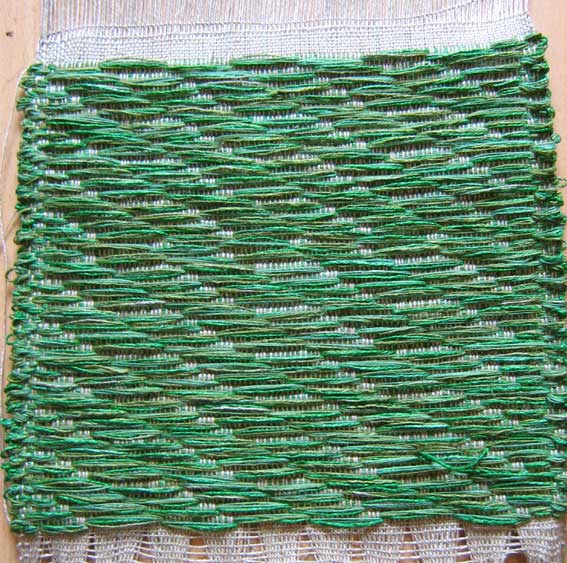
Now the "grass carpet" is woven, too, still in twill coruroy. I used five or maybe six different yarns for the weft, in cotton and linen.
Here it is, hot from the loom:


About the cutting, Collingwood writes that there are two ways: either you cut "straight up" or you follow the "twill line". I may have misunderstood how to cut "straight" - found it very difficult to identify the logical "straight".
Anyway - to the leftit is "twill cut", to the right it is "straight". The right side has pile of different lengths, but it doesn't really show.


Apart from the fact that a table loom is too flimsy/weak to properly beat a structure like corduroy, I also found that I have too long tabby stretches (or perhaps I should have used a different pile weft) - the ground shows too much.
(OTOH - we've had a dry spell here - it almost looks like my real grass-carpet, er, lawn:


As a comparison, here's my only previous experience of corduroy - a proper rug quality, with proper rug yarns. I wove it ages ago, and usd it for my weaving bench. It is double corduroy, and the two parts are cut with different methods, with a bit of un-cut in between. I tried to figure out which part was which, but I couldn't...


Still pondering how to achieve the flight of the cellophane one. Maybe I should try it with fishing line for warp... but that has to be on a "real" loom, if at all.

16/07/2010

Flying carpet?

The new theme for our guild is RUGS.
As you may have guessed, rugs is not what I usually weave. So, to make things more interesting, I decided to weave (very small) "different" rugs. Like... a flying carpet?

Literature studies did not yield much on the construction of flying carpets, so I made a few guesses: wings, it will need wings to fly, yes? And wings... fly wings, bug wings, fairy wings, they are all transparent and shiny? So: cellophane for weft.

The first technique that came to mind was rya knots. But I wanted to thread for something more, er, efficient, so I threaded up for what Collingwood calls double corduroy.

Here are the first samples:


The knots were impossible. After two rows the tension was completely off, and my patience was rapidly waning.
Went on to the double corduroy. In the first sample I used the warp yarn (linen 16/2) for the tabby picks, and also extended the tabbies some.
For the second sample I used the cellophane for all wefts. It looked better, but was too stiff for the hazy idea I had about mounting (a flying carpet has to be flying), so I re-threaded to what Collingwood calls twill corduroy.


It is now woven. I meant to do a "woven edge", but (as you can see) I have to practice a lot before I can do one that looks ok. With patience thin again, I decided I could do a plaited fringe at the other end...


This, too, is a bit stiff, but if I re-think the mounting...
In the meantime, I'm weaving off this short warp as a grass carpet (the word "lawn" could work in a textile environment, but hardly about rugs).

The techniqes of rug weavingcan be downloaded from handweaving.net.