22/02/2012

The profile draft challenge

The challenge in a nutshell: take this profile and "run with it" - completing, changing, interpreting, networking... and tell us what you come up with!

Some background:

A couple of years ago my local guild thought it would be nice if our national guild would present weaving ideas and/or drafts and/or complete instructions now and again.
We proposed that to the AGM, and we got very differing reactions – some thought it a great idea, others said they would never, ever "give away" their work for free. (If I tell "them", then "they" will know as much as I do – and then, where would I be?)

A year, or maybe 2, later it was decided that we should give it a try. (Now we have 26 "Månadens väv" published, all in .pdf-format. All are welcome to download and be inspired!) Me and my guild, being responisble for the idea, have taken it rather too seriously to supply drafts. (In fact, we have sent in over 30% of the drafts, having 2% of the members of Riks.)

"The usual" did happen: "oh, what a good idea – I love to see all the new weaves!" "What? Me contribute? But I’m not good enough/have only 4 shafts/only weave on a drawloom/..." (Note: nobody says, to my face, anyway, that they don't want to share.)

So I decided it was time to do something – and, in the last guild mag, I issued The Profile Draft Challenge (or click here for Swedish.)

I hope we can get at least 12 Månadens väv out of it!!!

After thinking a bit further, I decided to extend the challenge/invite to weavers from all over the world. (I may not be authorized to promise a publication as a Månadens väv, but as I am webmaster for the local pages, I can do what I want with them, right?)
To make the challenge even more open/accessible, I started a group on Weavolution, too.

So now I invite those of my readers who are neither members of Riksföreningen för handvävning nor members of Weavolution to at least read about it – and then maybe to become members of one or the other (or both!) – and join the challenge!

To get a .wif, you have to go either to the guild page(s) or to Weavolution.

21/02/2012

Crackle – corrections

Thanks to Laura, I now have re-read the Tidball book.
What I remembered was wrong (or came from another book altogether).

Tidball does indeed advocate three colours, but in a way different than I thought:
(easier to scan than to type it...)

A bit later she also writes that she uses "a heavy dark and two fine light colors".

So let’s go back some. Here is the profile, again:

Here it is, the threading again converted according to Tidball’s system. I don’t know what she means with “follow the rythm”, but this is a guess.


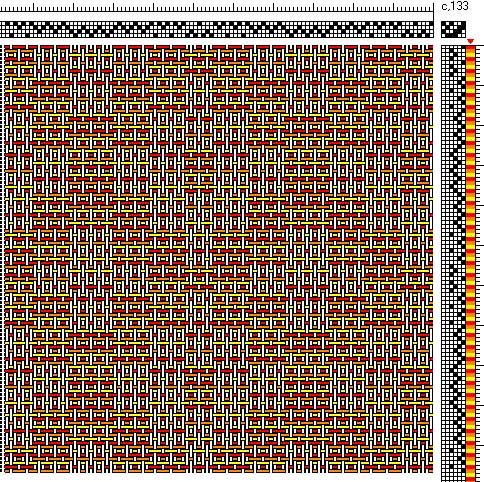
Using Tidball’s treadling system (as above – assuming that "block A" is the leftmost), and the recommendations to use one dark heavy weft and two fine light wefts, it looks like this:


(Again, I rotated to make it bigger in the picture-wiever)
Note that, according to the treadling specifications, there is one extra light-coloured pick "for the transition", which means there are two same-coloured picks at the block changes.
(But why the two light colours?)

For truth’s sake, I should also quote another sentence: "Weaving as drawn in is not commonly attemped in crackle, though the Swedish books contain many crackle (called Jämtlandsvaev) drafts for elaborate symmetrical patterns, symmetrically woven." (Me, the dumb Swede, can’t se any obvious relation between symmetric draft, symmetrically woven, and "as drawn in"... And I still haven’t seen any Swedish jämtlandsdräll woven any other way than "as overshot".)

However. Several of the (north american) weaving softwares often want to use tromp-as-writ, if left to their “automatic” preferences. So the mystery still remains: why tromp-as-writ?

08/02/2012

Finished honeycomb samples

I wove the three samples from here – that is, I omitted the one that would result in two separate layers.

This is what they look like, unfinished (scanned):

the original Maja draft (and a correction to last post – it calls for *22* ends per centimetre, which is why a doubled warp means 44 epcm).

the double-sided, with just one "cell" weft.

and the third, which has 2 cell wefts, the layers being connected by the outlines.

We abused them as best we could – hot water, vigorous washing, more hot water, wringing, drying in dryer… the lot.
Nothing very exciting happened… here they are, finished and scanned:

reacted as predicted. Obviously the widths of the cells (warpwise) are important, as is the depth (number of picks). Comparing the results to some old-ish pieces I have met, I can see that, if the cells are small enough, there is no need for the thicker outline weft.

did not really develop any “cells” (also more or less as predicted). However, if we adopt the old name “bed cover weave”, I would say this is better than the original. After all, it has a serviceable wrong side.

was more of a disappointment to me. I had thought there would be more distortions - . Perhaps “longer”cells (more picks) would have made a difference? Longer cells would have meant more space for the floats (but would of course have generated more floating yarns, too).

Will I ever try the more complex (and even thinner) Hulda Peter’s honeycomb? No, probably not... Would I try a double-sided with somewhat thicker yarn? Well – perhaps it would make a sturdy draft-breaking door drapery - which could be made in several other more interesting structures, instead...

01/02/2012

First honeycomb samples

So I took up Laura’s challenge to bring woven samples when I visit - .

The original Maja draft looks like this:


It calls for cotton 30/2 set at 22 ends per centimeter.

As I wanted to experiment with giving it a useable reverse side, I needed a “back” warp, which meant I had to have 44 ends per cm. (That means 44 x 2,5 = 110 ends per inch, so my american readers don’t have to convert... :-)

I wound some 800 ends (lost count somewhere after 825) to the shortest warp I dared put on the AVL – 2,5 meters, about.

Threading was ok, sort of. I made several widths of cells, from Maja’s 10 and 4, to max 40 and 40, to see if/how the width would influence the results. I ignored the selvages.
Then came the sleying... After some thinking, I decided to sley 9 ends per dent in a 50/10 (metric) reed, which would give me 45 ends per cm. With the odd number, it meant I have an average of 22,25 epcm and “layer”.


It turned out I made two sleying mistakes, but I solved them the alexandrian way: I just cut out 9 ends at each place. (It is a sample, after all, so it doesn’t really matter.)

Then I started weaving. Too soft tension. After several tries I had a tension so I almost couldn’t advance the warp, but I really would have liked i higher. (At least it is my experience that very tight cloth requires very high tension.)
It turned out I had made a couple of silly mistakes when converting the draft to dobby, but after some corrections I had it right.

The red portion is the “simple cloth” (ie the extra warp floats at the back).
Then I switched to blue weft and the double-sided (one-weft) version.


As I was very curious about how the back looked, I just pointed the camera to the underside...:


Of course, with wet finishing it may yet come out ok!

Having a backing warp also took care of the selvages – at least at the left side. Had I used two shuttles for the outlining weft I would have had two nice selvages (I think).

(Yes it is blurry)

This is the weaving draft for the double-sided – rotated to “fool” the image-viewer:


(Laura, shall I bring them unfinished? Then we both can share the excitement... or the disappointment, of course)

24/01/2012

Playing with software

How did we ever manage to experiment with strange ("new") structures before there was weaving software?
The answer (true for me, anyway) is: we didn't. Or, at least, I did not do it often – or, at even lesser (probably nor correct English, but you get my drift, I hope!) I did not often experiment with several layers.

This began with Maja, again. Her honeycomb isn't very interesting, except the quality: she used cotton 30/2 for warp anf weft, doubled for the outlines. (Ok, 30/2 doubled is double the thickness, but in most examples I've seen the difference has been a lot bigger than that.)

I have never woven honeycomb. One of the reasons is that I don't like structures with a so very obvious "wrong side". So I started to speculate... what if?
What if I tried to make a "back" – would I still get the weft distorsions?

This is the original draft


First, I tried with making the cell weft make cells on the back where it would have floated (back side to the left, right side to the right):


Only one cell weft, binding either on the right side or on the wrong. I decided I would have to use double outline picks (two each side), or the outlines would never distort. (As usual, the colours are there to make the draft more readable. You may not agree, but I find it easier, anyway.

Then I thougt that perhaps the non-floating weft would prevent the distorstions. New try:


Hm. This will make two separate layers (I think). If I wished two separate layers, I could as easily sew them together.

Another try:


Here the cells occur at the same place in both layers. Both warps, and both wefts float at the same time. To make the layers connect, I used only one outline weft, picking up one end from each layer.

Dear readers, especially those of you who have woven this structure: what do you think of my chances? Will any of these drafts give me distorted weft (except the original)?

And what did they do for the selvages – were they just hemmed? As I have shafts available, I think I will try to get a small selvage. Maybe some basket weave?

09/01/2012

Weftfaced, with 3-colours

seems not to be the answer.

At least - what I (think I) remember about the 3-colour version was that the colours should always rotate the same, 1-2-3.

Laura suggested the 3-colur version was meant to be woven weft-faced.
I took the draft from yesterday and asked for a weft-faced representation:


Hmm - but we all know that shifting the colours can make big difference. Below left started with orange, then yellow, red - below right the order is red, orange, yellow.


Apparently it is not THE solution...

08/01/2012

Jämtlandsdräll (not-quite-crackle)

Alison gave me an idea - what if the (obviously quite often) missing treadlings in Swedish pattern books gave Davison the idea to "always" use tromp-as-writ?
(I leafed through Davison, and don't think she really does that "incorrectly" very often)

But: whence came the idea of tromp-as-literally-writ for jämtlandsdräll?

Now I have a theory: many (Swedish) books tell you something like: (usually after an explanation of how to determine the tie-up) "the treadling proceeds according to the profile threading" (trampningen följer partisolvningen)..
So, if you are not good at reading Swedish, this may look almost like "treadle as threaded" - with the little difference that we (Swedes) read it as, well, profile threading.

For jämtlandsdräll, determining the tie-up can be somewhat trícky. Below is my attempt to translate from Varp och inslag (ISBN 91-27-35226-9 B):
"   Tie-up:
Two shafts will be tied to each pattern treadle.
If two blocks weave pattern at the same time, tie the shafts that are common to both blocks. Ie: block 1 is threaded on shafts 1,2 and 4, block 2 on shafts2, 3 and 1. Shafts 1 and 2 are common to both blocks, and are tied to one pattern treadle.
If one block weaves pattern [where the others do not], then tie two shafts that do not give pattern in other blocks. Block 1, for instance, can be tied two ways: either shafts 1 and 2, or shafts 1 and 4.
If the pattern contains both "single-pattern" and "double-pattern" blocks it is easiest to start with the "double-pattern" blocks.   "
(Probably not the best of translations, but...)

After experimenting with a very typical jämtlandsdräll profile, making substitutions according to (slightly) different rules, this is what I have got:


Substituting it "our" way, we get this:


As you can see, the pattern treadling follows the profile treadling, with tabbies in between. (Of course, in this instance, the profile treadling does not follow the profile threading)

Using that same threading, but woven-as-literally-drawn-in, we get:


We will never get the correct pattern - (ie the pattern the profile shows) because the treadling order should be different.

Letting PCW do the block substitution (and then fixing the tie-up - jämtlandsdräll tie-ups should always "be determined" os of above):


But - isn't this another variant of the pattern?
Making it two repeats (and turning the picture, hoping for better visiblity in blogger's new picture-handler) shows that it is indeed so:


Letting PCW do the substitution in "twill form" gets us something very like the original profile (after fixing the tie-up, of course). The differences there are can probably be "massaged out". The reason is that this follows the original profile treadling.


(I extended the pattern repeat to two, in most figures, to get a better wiev of the overall pattern. In other pictures there is one repeat plus one block to balance.)

So, getting back to the original question - whence came the idea of tromp-as-literally-writ for jämtlandsdräll? Why are we not to follow the profile?

And, even curiouser: from where did (Tidball, I think - read it in an American book anyway) the idea of a tree-colour rotation come? (I don't remember if something was said about colour values, so I just used red-orange-yellow):


But then, on the other hand, as Atwater writes (link goes to the document on handweaving.net):
so - who am I to tell what is right or wrong...

(ETA: seems I "fooled" the picture viewer: all pics become reasonably big if clicked, even the turned one!)