04/01/2015
The bad-idea and it's sample
Never mind what the end idea is - I wanted something completely reversible, and it had to have a supplementary weft.
This sounds like overshot (daldräll), so I started with the traditional cat's paw pattern. After adding another "block" and a "turned" tieup, I had this:
Could perhaps be interesting?
Then I made one (of probably several) bad decisions: what if I put it into the fan reed?
Now, the fan reed has 26 dents per fan, so I had to reduce the repeat to 26 profile ends (each representing 2 warp ends). Then I had this:
Still recognizable... perhaps. The treadling can be reduced in various ways, and is perhaps better left until the actual weaving. But wait: I have to have an idea of when/how often to change the reed position... some possible variations:
Now, no doubt you all wonder why I didn't abandon the idea right here? Looking back, I wonder, too. (But is was only some 180 ends, and perhaps it would be interesting, and...)
The end product is (was, for this try, anyway) to be relatively low-contrast, but for the sample I used what was nearest at hand: a narrow white cotton warp and a blue-green already-wound quill, also cotton. (Maybe, but only maybe, it would have looked better with lower contrast...)
(washed and flattened, but not properly pressed/mangled)
I'm sure you all agree that this sample has no future...
(Next try will, perhaps, be a biggish waffle weave. If I can figure out a way to use a discontinuous weft.)
Bonus: with a bigger scale (which of course makes it a dräll rather than an overshot - thus min 24 shafts, preferably 32 or 40), and a natural linen on a white warp, I still think the pattern is "good enough":
Labels:
dräll,
fan reed,
sampling,
weave construction,
weave planning
01/01/2015
Loomsday
I had an idea, but after a short sample it was obvious that it wasn't a good one.
After cutting off:
Three "fans" and a few dents, will probably rethread to another idea...
Loomsday is organized by Meg, and this is the first time I have participated.
After cutting off:
Three "fans" and a few dents, will probably rethread to another idea...
Loomsday is organized by Meg, and this is the first time I have participated.
17/12/2014
Local newspapers
Who said that local newspapers mostly contain local gossip?
Well, at least that is what I have always thought. So today I went to the local archive to read Nya Wexiö-Bladet for 1847 - the year that Mlle Granberg was touring the county giving classes in double-spinning.
I anticipated coming home with lot lots of "gossipy" information, such as Joahnna Månstdotter and Lina Andersson did attend the class in Lenhovda, and after only a week were able to spin 3 "pops" (knäpp) weighing only 2 "lod", or somesuch. Hopefully I would find advertisements and, and...
But. No such luck. In fact, almost no luck at all.
I found a few names, but those all belonged to remarkable spinsters from before the classes.
I found no advertisements at all (for things relevant, such as the classes themselves, spinning wheels, "modern" hackles...). Also I found nothing about the actual classes, not even the slightest mention!
What I did find was a kind of "morality", in the form of a conversation between "Mrs X", "the girl" and "the uncle":
Mrs X didn't want to send her maid to the spinning school, but the girl (niece of Mrs X, in fact) was going, because the uncle had said it was a Good Thing To Do.
Enters said uncle, who proceeds to tell the Ladies why [double-flyer] spinning school was such a good idea: it was "ancient" (had been used in Brabant for over 100 years - imagine that!); it would give work to paupers [my comment: why couldn't they get work spinning on a normal wheel, if spinsters were so sought-after?]; he gave a long lecture about the economics [interesting, but it will take some time until I can untangle all the various measurements used]; last, but not least: the Ladies ought to resume the responsibility of being Role Models.
Nearing the end of the economic lecture, Mrs Y enters. She gets all interested, 'cos that would mean she could turn away beggars without any remorse. Mrs X is nicer, she doesn't like to turn away hungry women without giving them something to eat.
The girl is excited, says she wants to go. [But that was her intention from the beginning]
This was quite a long article, but it ended without any mention at all about how to enrol, who was organizing the event(s), when and where they were to take place.
(Ok, so there might have been mentions I didn't see, but if so, it was in the middle of the "running text" - no advertisements, no "marketing".)
Maybe it wasn't so strange that (at least) one of them had to be cancelled due to low interest? I have found, in another publication, that four or five *were* held, one of them with more than 20 students. There were students turned away because of lack of double spinning wheels. (If you follow that link, don't tell anybody. Taking pics was allowed; showing them is not. Makes sense?!?)
So here comes a "legitimate" picture:
Labels:
curiosities,
DFW,
double flyer wheel,
spinning,
spinning wheels
15/12/2014
The never-ending story
or: yet some more pulleys
Considering I am a countermarche convert since first I tried one, it is interesting how odd counterbalance set-ups seem to come my way...
Have been to a flea-market again. Found some CB pulleys again. This time a pair of homemade(?) two-level type:
They look almost like the standard type, still sold:
- with the exception of all the extra holes.
They must be there for a reason, but which? To change the position of the pulleys? But if so, why?
DH speculated it was to be able to maximize the shed size.
But would that even be true, as, after all, the size/length of the horses (and their cords) must be so much easier to change than having to fiddle with a peg?
(Also considering the height of the reeds "way back when" - my old reeds measure between 5 and 8 cm, so theoretical shed size cannot have been a big question :-)
I left them at the flea market. Should anybody be interested, they will probably still be there for some time... light-weight and easy to pack. (Price? Don't know, unmarked) - come to think of it, there were also a couple of old-fashioned dräll pulleys, more or less like these
though I can't remember if 3, 4 or 5 levels. Again unmarked, but perhaps I could get a good price for both?
(If they are to be sent by post, they will probably not reach anywhere before x-mas)
Considering I am a countermarche convert since first I tried one, it is interesting how odd counterbalance set-ups seem to come my way...
Have been to a flea-market again. Found some CB pulleys again. This time a pair of homemade(?) two-level type:
They look almost like the standard type, still sold:
- with the exception of all the extra holes.
They must be there for a reason, but which? To change the position of the pulleys? But if so, why?
DH speculated it was to be able to maximize the shed size.
But would that even be true, as, after all, the size/length of the horses (and their cords) must be so much easier to change than having to fiddle with a peg?
(Also considering the height of the reeds "way back when" - my old reeds measure between 5 and 8 cm, so theoretical shed size cannot have been a big question :-)
I left them at the flea market. Should anybody be interested, they will probably still be there for some time... light-weight and easy to pack. (Price? Don't know, unmarked) - come to think of it, there were also a couple of old-fashioned dräll pulleys, more or less like these
though I can't remember if 3, 4 or 5 levels. Again unmarked, but perhaps I could get a good price for both?
(If they are to be sent by post, they will probably not reach anywhere before x-mas)
05/12/2014
AHA - so that's why...!
Once I wanted to weave with paper yarn, and to that end used one of the old wooden reeds.
After a while, I noticed that the dents were not evenly spaced:
Yesterday I came across the doubleweave portion of Zielinski's "Master weaver" where one can get several suggestions as to how to handle the fold when weaving double width.
(Methinks the first idea is the best: "experiment")
Transcription of the marked section (click, and most might be readable):
"Another method is to have special reeds made with dents growing wider towards the fold. Such reeds of rather old vintage can be found in antique shops. The difficulty here is that regardless of the width of the woven fabric the fold must be always at the edge of the reed, which may result in weaving off the center of the loom, unless the reed can be shifted in the batten at will."
I found that an adorable suggestion, which also might have explained my "variable" wooden reed...
Except it doesn't, of course. The open part wasn't even near one end, and wasn't even near to be systematic, whatever that may mean. And no, there weren't dents missing/fallen out, 'cos they usually show...
Labels:
curiosities,
double layers,
reeds,
tips-and-tricks
27/11/2014
More on patents and mangles
Jean noticed what should have been obvious to me, too: the patent drawing is different from the "real thing". This made me read the patent text more carefully - and it turns out that the machine in the drawing probably was never built. It is couched in some complicated language, but essentially the text says "this is one possible construction".
Last, in the text, are three patent claims (is that right? "patent wishes"?) - 1) a tabletop mangle with a lower roller lifted with help of a two-armed swiveling lever and a spring, 2) same as 1, with the addition that the two-armed lever is angled and 3) same as 1, with the addition that the arm which connects with the spring is longer than the other arm.
Here are a couple of detail pictures:
How the spring is mounted:
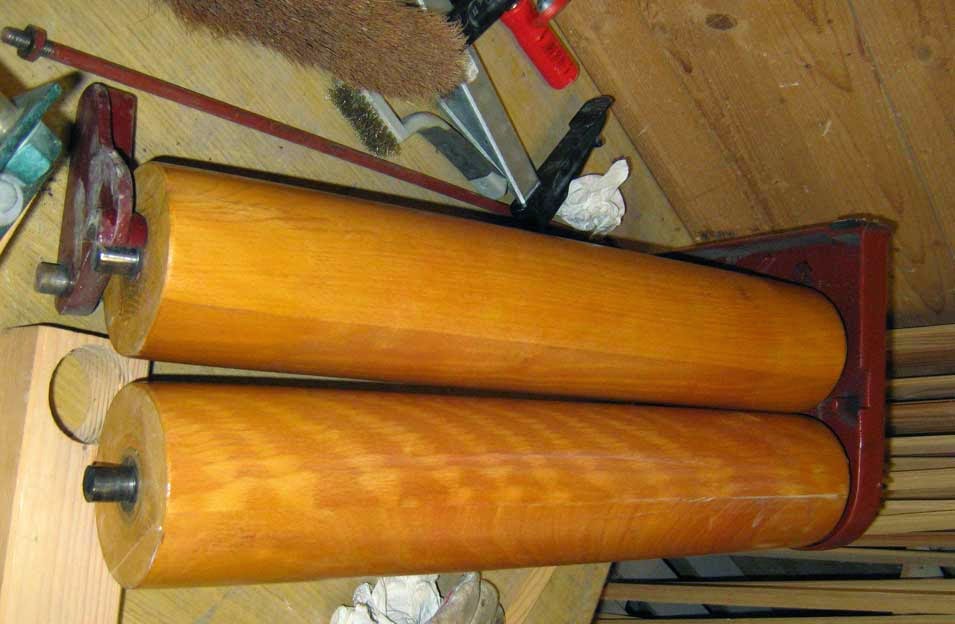
The rollers (and the "swing", or two-armed swiveling lever) exposed:
(yes, the picture is turned - this is the way the rollers go when the mangle is operational)
And now we all can see that the actual construction is even more different from the patent... And, yes, it is the right patent, because the patent number is written on the side piece:
As for "apron" or no apron - I don't know. Before the mechanical mangle, there was the roller and the "plank":
(for many fantastic carved boards - they were often very decorated - go here)
Anyway, from what I have read, these were used either "as is" or with a special "mangle sheet": roll the cloth (with or without the protector) as tightly as possible onto the roller; grab the board, lean hard on the board and roll in the same direction as the cloth had gone on; when you reach the end, slide the roller back towards you; repeat.
Next came the box mangle - like this or this (or, for the scary pictures, this!). From what I understand, one of the ideas with the mangle sheet was that you could load several smaller pieces in one go - but I think that it also helps with the "sheen".
All the older "small" mangles with the big spring on top I have seen have been without apron. Come to think of it, mine may be one of very few having the apron.
All modern mangles have it, though.
As for adding one: I think the important bit is getting the roller smooth again - no ridge, no screw heads...
Last, in the text, are three patent claims (is that right? "patent wishes"?) - 1) a tabletop mangle with a lower roller lifted with help of a two-armed swiveling lever and a spring, 2) same as 1, with the addition that the two-armed lever is angled and 3) same as 1, with the addition that the arm which connects with the spring is longer than the other arm.
Here are a couple of detail pictures:
How the spring is mounted:
The rollers (and the "swing", or two-armed swiveling lever) exposed:
(yes, the picture is turned - this is the way the rollers go when the mangle is operational)
And now we all can see that the actual construction is even more different from the patent... And, yes, it is the right patent, because the patent number is written on the side piece:
As for "apron" or no apron - I don't know. Before the mechanical mangle, there was the roller and the "plank":
(for many fantastic carved boards - they were often very decorated - go here)
Anyway, from what I have read, these were used either "as is" or with a special "mangle sheet": roll the cloth (with or without the protector) as tightly as possible onto the roller; grab the board, lean hard on the board and roll in the same direction as the cloth had gone on; when you reach the end, slide the roller back towards you; repeat.
Next came the box mangle - like this or this (or, for the scary pictures, this!). From what I understand, one of the ideas with the mangle sheet was that you could load several smaller pieces in one go - but I think that it also helps with the "sheen".
All the older "small" mangles with the big spring on top I have seen have been without apron. Come to think of it, mine may be one of very few having the apron.
All modern mangles have it, though.
As for adding one: I think the important bit is getting the roller smooth again - no ridge, no screw heads...
22/11/2014
Yet another mangle
this one compact, and patented.
The patent is interesting, as it is granted in 1937, but valid from '34. It contains a drawing, a very enlightening one (as you can see):
It was a bit fiddly to get apart - and I couldn't get the right-hand piece off. Or, well, I decided I did not need to get it all apart. (The cog wheels are very securely mounted)
(So why take off the left-hand piece at all? 'Cos the rollers needed some work, that's why.)
The spring is, well, a standard one:
There are some "golden" details:
The rollers, after some sanding and lacquer:
Now all that remained was to put it together again. Should be a piece of cake, yes?
Well.
It really wanted to have four pieces in four holes at the same time - the back connexion rod, the upper roller, the bottom "swing" for the bottom roller and the front "spring-holder" all connect to the left side, plus the bottom roller needed to be in its cradle on top of the "swing".
Everything would really have been easier if I could have had the spring in place, too, but I only have two hands... After much fiddling (and some new words) I managed to get the spring in place, later. (This type of spring isn't one one just "wrestles" in place.)
Before putting the table in place:
(When do I have 'nuf mangles, you ask? Well, I like to rescue them - and on occasion I do re-home them. This one has just moved to Denmark, and I might consider selling this one, too - weighs about 25 kgs, so pick-up is a good idea...)
Subscribe to:
Posts (Atom)