18/04/2011

Ungrateful!

I can't really blame the sheep for wanting to get out. It really is a lot greener on the outside (but all that is green is not grass, what should be "lawn" is mostly moss).
This is what I saw from the upstairs window a couple of hours ago:


They (actually, just this individual) kept escaping last week, so on the Saturday we spent hours fixing a better (bigger) pasture. There's not much grass there, either, but it certainly looks greener. See the line between the winter paddock and the "pasture"?


But... the ungrateful creature decided "lawn" was better, after two days on the greenish pasture. I could not understand how she had got out - the fence is well over a metre. But I was lucky: she wanted in again. Tried the gate first (maybe it would magically open?), gave up that and went to a special part of the fence, flattened herself completely and wriggled under. (I had never imagined a sheep could get that flat!)

... so I found some pieces of reinforcement bars (is what the dicitonary calls it?) and made some oversized staples. They "only" go 20 cm into the earth, but maybe they will hold a couple of days, at least.


Life is never dull with livestock (or perhaps I should call them "woolstock"?)!

12/04/2011

Pigs?

Sunday was shearing day.

Before and after:

(those pink things can't really be sheep, can they?)

The shearer had a special table, to have a better position when working.


One-by-one there emerged some small, pinkish animals - pigs, perhaps? When the first was "done" and released, the others almost did not recognize their comrade, and there was a lot of running and head-butting.


Obviously they liked to be naked. The immediately tried to escape (and succeded).
Stupidly, we had left the plastic easy-to-move fence over winter, and it did not survive the heavy snow. We did make a smallish paddock with electrified wire, which worked fine as long as they were all woolly. Naked, they could crawl under... the bottom wire was a bit high, now the snow has melted.
When we had fixed the "winter" fence, they accepted to stay inside. Until... one managed to climb the stone wall (something they never even contemplated when woolly). She told the others, of course, and it took me a couple of hours to put up another piece of temporary fence.

The whites all are crossbred - we were told they were mostly Finn, but crossed with Texel (and possibly Shropshire). To keep track of what the wool looked like, and which fleece belonged to which sheep, I took a lock from each, fingerspun a short piece and labeled the sample. It appeares that out of four sheep, I have three different wool types.


(The two brown are Finn, and their fleeces are quite alike. And looks like typical Finn wool :-)

But, before I can do anything more, I have lots of wool to wash...

19/03/2011

A small mangle

Let me present a small table-top mangle:


It is not exactly portable, as the stand and mechanism are cast iron. OTOH, it stays put :)

To change the pressure, there is a spring under the front "table" (that is easily lifted out):


There is a protector sheet fastened to the top roller:


This sheet should preferrably be longer, but I haven't bothered to change it. Shopping for a  "mangle sheet" in Sweden will get you a piece of tightly woven (plain weave) unbleached linen.

To use it, put the (in this case) towel as near to where the protector sheet is fastened as possible, the hem as parallell to the roller as possible, and lower the "clutch" bar. The bar is both what engages the gears and also to protect your fingers. Start cranking, just to make sure the towel is in place, and held.
As you go on cranking, make sure the towel stays flat (always smooth it towards the sides). When it has gone a three-quarter turn, the hem is visible through the protector.


The "bump" of the hem will show on the towel - the only way to avoid that is to let the towel go straight through - like I did with this shawl:


(click to biggify - you can see the shawl coming through to the right)

Once the towel has all gone onto the roller, you crank away "until done" - then disengage the clutch bar, and drag the mangled piece towards you. The top roller spins free when the bar is in the up position.


For best result, the goods should be slightly moist. If it is dry, sprinkle with water and let it sit for some hours in a plastic bag, to let the moisture even out.

18/03/2011

An experiment with skeins

I aquired some 3,5 kg of fine cotton yarn (probably 24/2) the other day. It is skeined, and some skeins have brownish stains.


As there were many skeins, I decided to risk losing a couple - selected two stained ones, put in a number of extra figure-eight ties. Then I washed them in the washing-machine. One skein was in a bag, the other was "free".
To minimize the possible tangling, I selected the programme called "hand washing". Unfortunately, that programme will not heat the water above 30 degrees - to get higher temperature, one also get so much more vigorous washing.


The last picture is not in focus, but shows the two skeins when still wet. As you can see, they did survive!

Unfortunately, I lost sight of the stains as soon as I stretched out the skeins, so I can't tell if they did get clean or not, but at least they smell nice! Now, the big question is: was this just beginner's luck - or dare I do the same to the rest of them? And... dare I hope it will work without the bag, net time, too?

11/03/2011

But how did...?!?

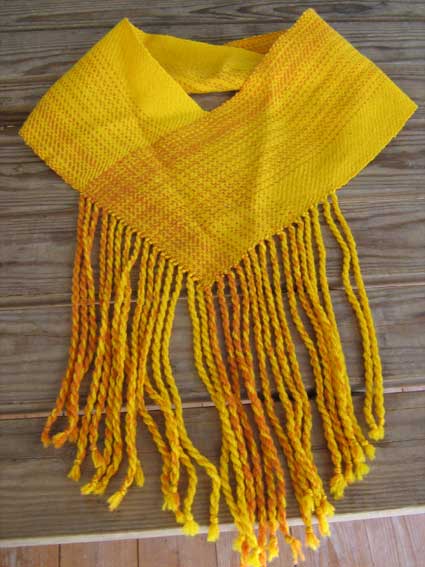
I first saw them on Weavolution, here and here, and was intrigued. I do know how to make V-shaped shawls - but they have two ends. These were closed!

I saw they were made on a Cricket loom, which is a rigid heddle loom ("loom", here, means it has both warp and cloth beams).

Hmmm.

I saw how one could make one by using a rigid heddle with body tension (thus being able to apply warp tension without a cloth beam), but I could not think of a way to make them on a "beam" loom.
(I should say: I have no idea how Lydia Kendrick makes hers!)

Until the lightbulb went on: I have a sandpaper beam! As the whole meaning of the sandpaper beam is to maintain tension between warp beam and freshly woven cloth... eureka! (I hoped)


So I decided to try: measured my head (65 cm should be enough), put on a 15 cm wide warp, and started weaving. As the bobbin run out after 62 cm, that would have to be enough... and I started the V part. (This is when the Moebius shape is put in - the yellow side is "outside" on the loom, so it should be on the "inside" when the V is started)


It looked like I had used a too light beat, and had it been more than 120 ends I might have scrapped it - . It is so much, er, "fiddlier" to find the corredt end and getting the weft tension right than one would think...


After cutting the warp, I wrestled the thing off the sandpaper beam (after taking it off, of course), and, here it is, fresh off the loom:


Honestly, it did not look promising... but after burling and mending (more than I care to tell you - when weaving on an AVL, always remember to step decisively on the left treadle!), fringe twisting, wet finishing and pressing it looked nice enough that I wore it to the guild meeting yesterday!


(Maybe I should have pressed it again - it has sat in a drawer overnight)

Now (the day after) I can say it was a fun and fast project - maybe I should make more?

27/02/2011

Hålkrus?

Evelyn posted a question over at Weavolution. She asked how to treadle pattern no 44 (Hålkrus) in Vävbok by Hulda Peters.

The book in question is but one of many - in the early 1900s there were several small books containing "simple" (or perhaps "traditional"?) weaving patterns. They were often thin pamphlets (the Peters book is, in fact, unusually thick - all of 96 pages), often claiming they are describing "local" weaves.
This, I suspect, was the time when Daldräll ("overshot") was associated with Dalarna, when Jämtlandsdräll became "typical" of Jämtland, when Gagnefkrus was attributed to Gagnef, Östgötadräll to Östergötland, Rovadräll to Rova... and Smålandsväv to Småland.

Peters is, at the time, manager of the local Craft society shop in Skara. She is quite unique in that not one of her threadings has a geographical name.
She is also unique in that she does not give any treadlings... The detailed threadings are there, the tie-ups are there, and occasionally she gives some off-hand treadling instruction ("treadled back-and-forth").

The hålkrus, #44, has the threding and the tie-up. It also has a picture - (click to biggify):

As hålkrus usually has well-defined "holes", it is easy to doubt the name. Or, at least, to be confused...

(This picture from the book Varp och inslag, ISBN 91-27-35226-9.)

As I don't like to be confused, I did some research. It resulted in a new article on my web site - read it here.

I also wanted to know what you called it in English, I tried googling.
At handweaving.net I found an excerpt from Master weaver from 1954, titled "Hålkrus, or Gagnefkrus, or Spetsväv, or Lacey Weave, or Honeycomb". It says: " Strangely enough this weave with so many names, has none in English. In colonial times it has been called Honey Comb. Since then however the industrial weaving adopted Honeycomb as a synonym of Waffle. So if we want to call Hålkrus by the name of honeycomb, we must add Colonial, or nobody will know what we are talking about."
So, I googled honeycomb +weave - and, sure enough - most hits I got depicted what I would call waffle - this (scroll down a bit), and this - in fact, there are several waffles on this site, all labelled honeycomb.

Conclusion: the more you know, the more you know that you don't know...

(Please, can I have all possible names for the technique? Don't mind the language!)

21/02/2011

In case you wondered:

I am not a collector.
The fact that I own 6 electric sewing machines, 4 treadle machines, one hand-cranked and 3 sergers does not mean I am a collector.

The other day I met with the glass-industry study group (don't ask - or, take a look at the glass portion of my other blog) we came to discuss collecting. They declared themselves to be collectors (of glass, mostly), and offered me a definition: a collector has no interest in if the thing (maybe I should say artefact) "works" - if only it looks "good".
And more: a true collector would never use the thing (artefact) - if s/he has paid good money for a (say) glass vase designed by (say) Gate, s/he would perhaps put it on a shelf somewhere, but would never even dream of using it to put flowers in. (Knowing some of the self-proclaimed collectors a bit better, I would suspect
the artefact would be placed in a box somewhere, the new owner hoping it could one day be sold - an investment, in fact.)

The idea of restoring an artefact is unthinkable, I was told.

So - I am not a collector.
Well - maybe this one is more for looks than for (even potential) use:


He is, as you can see, called Shakespear and was born in Birmingham. The manual that came with him is dated 1865 - but, according to this site that can't be true. I bought him for his looks - but: he sews! He is a chain-stitch machine, and it is awkward to have to dedicate one hand to the cranking.

My mother gave me my first sewing machine when she got a newer Adler. This is a Singer, and she got it from her mother as a treadle machine. Mother invested in an upgrade, and he has been motorized in all my life. He still sews beautifully, and I use him for "important" edgestitching. Unfortunately, the treadle is unconfortable if used for any length of time. At the moment, he sits on a shelf.


Later, I bought a Husqvarna (in 1972, if memory serves). She served me faithfully until last year - and I will probably have her repaired. (Why? because I'm an idiot - and found a new Elna for approx the same price as the repair would have cost. I suppose it works - but there are no feet for it. AND the "standard" feet that I have been able to mount on ALL the other machines don't fit. Sigh.)
When I started to sew professionally, I bought Princess Pfaff, but I also needed other machines - topstitching in grey, green and yellow took way to long if I had to re-thread for each gown. I had the Singer and the Husqvarna, but I also retrieved the old Adler...

In the meantime, as I had space, I found an old treadle machine - a Husqvarna Triumf - a machine with a shuttle (instead of a bobbin). After some, er, fiddling, he sews. The shuttle looks almost exactly as does a fly-shuttle for weaving - the problem was to figure out how to load the bobbin.
I know the Triumf was maufactured in 1889, but haven't found out for how long.
I especially like the plate with the recommendations of which thread to use with which needle!


Then came the Sackmann's Victoria - I couldn't resist her, with all the mother-of-pearl inlays!
She also has a shuttle, but it operates sideways. Her needle/thread recommendation plate photographed better, as it is flat. (And I wish there was a better choice of sewing threads nowadays!)


She also has another detail - a small grindstone to sharpen the needles! (It took a long time of gentle oiling to make it turn - but now it does.)


Some 'net-search results indicate that this was manufactured by Singer - but the picture on this site shows an inlay much like my Victoria's - and says she comes from Germany.

For some time I also had a Singer 29K70, like this, bought from the estate of a shoemaker. The most interesting feature of that is that the whole needle bar (or maybe just the foot) could be rotated - you could sew "forwards" and have the piece going "backwards". In my house, it was only used once - we repaired a sail with it. And one day, I had a customer who "gave me an offer I couldn't refuse", so it is now gone. Hopefully to a good home.

Anyway. As I am no collector, I can disregard everything, and just enjoy all my sewing machines - even USE them!

- There are other things I also don't collect - like encyclopedias. For readers of Swedish, the pages Kuriosa on my website have some thoughts on the use of encyclopedias through time...