19/03/2011

A small mangle

Let me present a small table-top mangle:


It is not exactly portable, as the stand and mechanism are cast iron. OTOH, it stays put :)

To change the pressure, there is a spring under the front "table" (that is easily lifted out):


There is a protector sheet fastened to the top roller:


This sheet should preferrably be longer, but I haven't bothered to change it. Shopping for a  "mangle sheet" in Sweden will get you a piece of tightly woven (plain weave) unbleached linen.

To use it, put the (in this case) towel as near to where the protector sheet is fastened as possible, the hem as parallell to the roller as possible, and lower the "clutch" bar. The bar is both what engages the gears and also to protect your fingers. Start cranking, just to make sure the towel is in place, and held.
As you go on cranking, make sure the towel stays flat (always smooth it towards the sides). When it has gone a three-quarter turn, the hem is visible through the protector.


The "bump" of the hem will show on the towel - the only way to avoid that is to let the towel go straight through - like I did with this shawl:


(click to biggify - you can see the shawl coming through to the right)

Once the towel has all gone onto the roller, you crank away "until done" - then disengage the clutch bar, and drag the mangled piece towards you. The top roller spins free when the bar is in the up position.


For best result, the goods should be slightly moist. If it is dry, sprinkle with water and let it sit for some hours in a plastic bag, to let the moisture even out.

18/03/2011

An experiment with skeins

I aquired some 3,5 kg of fine cotton yarn (probably 24/2) the other day. It is skeined, and some skeins have brownish stains.


As there were many skeins, I decided to risk losing a couple - selected two stained ones, put in a number of extra figure-eight ties. Then I washed them in the washing-machine. One skein was in a bag, the other was "free".
To minimize the possible tangling, I selected the programme called "hand washing". Unfortunately, that programme will not heat the water above 30 degrees - to get higher temperature, one also get so much more vigorous washing.


The last picture is not in focus, but shows the two skeins when still wet. As you can see, they did survive!

Unfortunately, I lost sight of the stains as soon as I stretched out the skeins, so I can't tell if they did get clean or not, but at least they smell nice! Now, the big question is: was this just beginner's luck - or dare I do the same to the rest of them? And... dare I hope it will work without the bag, net time, too?

11/03/2011

But how did...?!?

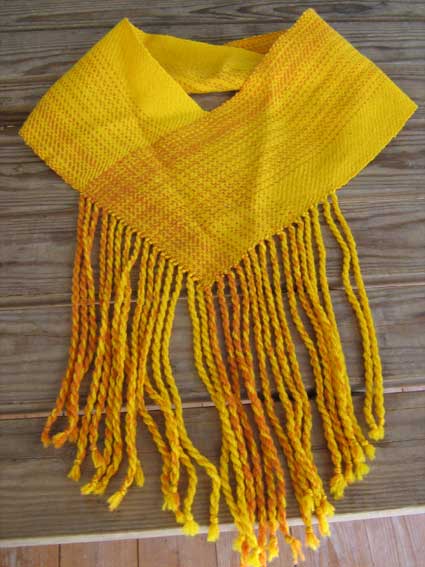
I first saw them on Weavolution, here and here, and was intrigued. I do know how to make V-shaped shawls - but they have two ends. These were closed!

I saw they were made on a Cricket loom, which is a rigid heddle loom ("loom", here, means it has both warp and cloth beams).

Hmmm.

I saw how one could make one by using a rigid heddle with body tension (thus being able to apply warp tension without a cloth beam), but I could not think of a way to make them on a "beam" loom.
(I should say: I have no idea how Lydia Kendrick makes hers!)

Until the lightbulb went on: I have a sandpaper beam! As the whole meaning of the sandpaper beam is to maintain tension between warp beam and freshly woven cloth... eureka! (I hoped)


So I decided to try: measured my head (65 cm should be enough), put on a 15 cm wide warp, and started weaving. As the bobbin run out after 62 cm, that would have to be enough... and I started the V part. (This is when the Moebius shape is put in - the yellow side is "outside" on the loom, so it should be on the "inside" when the V is started)


It looked like I had used a too light beat, and had it been more than 120 ends I might have scrapped it - . It is so much, er, "fiddlier" to find the corredt end and getting the weft tension right than one would think...


After cutting the warp, I wrestled the thing off the sandpaper beam (after taking it off, of course), and, here it is, fresh off the loom:


Honestly, it did not look promising... but after burling and mending (more than I care to tell you - when weaving on an AVL, always remember to step decisively on the left treadle!), fringe twisting, wet finishing and pressing it looked nice enough that I wore it to the guild meeting yesterday!


(Maybe I should have pressed it again - it has sat in a drawer overnight)

Now (the day after) I can say it was a fun and fast project - maybe I should make more?

27/02/2011

Hålkrus?

Evelyn posted a question over at Weavolution. She asked how to treadle pattern no 44 (Hålkrus) in Vävbok by Hulda Peters.

The book in question is but one of many - in the early 1900s there were several small books containing "simple" (or perhaps "traditional"?) weaving patterns. They were often thin pamphlets (the Peters book is, in fact, unusually thick - all of 96 pages), often claiming they are describing "local" weaves.
This, I suspect, was the time when Daldräll ("overshot") was associated with Dalarna, when Jämtlandsdräll became "typical" of Jämtland, when Gagnefkrus was attributed to Gagnef, Östgötadräll to Östergötland, Rovadräll to Rova... and Smålandsväv to Småland.

Peters is, at the time, manager of the local Craft society shop in Skara. She is quite unique in that not one of her threadings has a geographical name.
She is also unique in that she does not give any treadlings... The detailed threadings are there, the tie-ups are there, and occasionally she gives some off-hand treadling instruction ("treadled back-and-forth").

The hålkrus, #44, has the threding and the tie-up. It also has a picture - (click to biggify):

As hålkrus usually has well-defined "holes", it is easy to doubt the name. Or, at least, to be confused...

(This picture from the book Varp och inslag, ISBN 91-27-35226-9.)

As I don't like to be confused, I did some research. It resulted in a new article on my web site - read it here.

I also wanted to know what you called it in English, I tried googling.
At handweaving.net I found an excerpt from Master weaver from 1954, titled "Hålkrus, or Gagnefkrus, or Spetsväv, or Lacey Weave, or Honeycomb". It says: " Strangely enough this weave with so many names, has none in English. In colonial times it has been called Honey Comb. Since then however the industrial weaving adopted Honeycomb as a synonym of Waffle. So if we want to call Hålkrus by the name of honeycomb, we must add Colonial, or nobody will know what we are talking about."
So, I googled honeycomb +weave - and, sure enough - most hits I got depicted what I would call waffle - this (scroll down a bit), and this - in fact, there are several waffles on this site, all labelled honeycomb.

Conclusion: the more you know, the more you know that you don't know...

(Please, can I have all possible names for the technique? Don't mind the language!)

21/02/2011

In case you wondered:

I am not a collector.
The fact that I own 6 electric sewing machines, 4 treadle machines, one hand-cranked and 3 sergers does not mean I am a collector.

The other day I met with the glass-industry study group (don't ask - or, take a look at the glass portion of my other blog) we came to discuss collecting. They declared themselves to be collectors (of glass, mostly), and offered me a definition: a collector has no interest in if the thing (maybe I should say artefact) "works" - if only it looks "good".
And more: a true collector would never use the thing (artefact) - if s/he has paid good money for a (say) glass vase designed by (say) Gate, s/he would perhaps put it on a shelf somewhere, but would never even dream of using it to put flowers in. (Knowing some of the self-proclaimed collectors a bit better, I would suspect
the artefact would be placed in a box somewhere, the new owner hoping it could one day be sold - an investment, in fact.)

The idea of restoring an artefact is unthinkable, I was told.

So - I am not a collector.
Well - maybe this one is more for looks than for (even potential) use:


He is, as you can see, called Shakespear and was born in Birmingham. The manual that came with him is dated 1865 - but, according to this site that can't be true. I bought him for his looks - but: he sews! He is a chain-stitch machine, and it is awkward to have to dedicate one hand to the cranking.

My mother gave me my first sewing machine when she got a newer Adler. This is a Singer, and she got it from her mother as a treadle machine. Mother invested in an upgrade, and he has been motorized in all my life. He still sews beautifully, and I use him for "important" edgestitching. Unfortunately, the treadle is unconfortable if used for any length of time. At the moment, he sits on a shelf.


Later, I bought a Husqvarna (in 1972, if memory serves). She served me faithfully until last year - and I will probably have her repaired. (Why? because I'm an idiot - and found a new Elna for approx the same price as the repair would have cost. I suppose it works - but there are no feet for it. AND the "standard" feet that I have been able to mount on ALL the other machines don't fit. Sigh.)
When I started to sew professionally, I bought Princess Pfaff, but I also needed other machines - topstitching in grey, green and yellow took way to long if I had to re-thread for each gown. I had the Singer and the Husqvarna, but I also retrieved the old Adler...

In the meantime, as I had space, I found an old treadle machine - a Husqvarna Triumf - a machine with a shuttle (instead of a bobbin). After some, er, fiddling, he sews. The shuttle looks almost exactly as does a fly-shuttle for weaving - the problem was to figure out how to load the bobbin.
I know the Triumf was maufactured in 1889, but haven't found out for how long.
I especially like the plate with the recommendations of which thread to use with which needle!


Then came the Sackmann's Victoria - I couldn't resist her, with all the mother-of-pearl inlays!
She also has a shuttle, but it operates sideways. Her needle/thread recommendation plate photographed better, as it is flat. (And I wish there was a better choice of sewing threads nowadays!)


She also has another detail - a small grindstone to sharpen the needles! (It took a long time of gentle oiling to make it turn - but now it does.)


Some 'net-search results indicate that this was manufactured by Singer - but the picture on this site shows an inlay much like my Victoria's - and says she comes from Germany.

For some time I also had a Singer 29K70, like this, bought from the estate of a shoemaker. The most interesting feature of that is that the whole needle bar (or maybe just the foot) could be rotated - you could sew "forwards" and have the piece going "backwards". In my house, it was only used once - we repaired a sail with it. And one day, I had a customer who "gave me an offer I couldn't refuse", so it is now gone. Hopefully to a good home.

Anyway. As I am no collector, I can disregard everything, and just enjoy all my sewing machines - even USE them!

- There are other things I also don't collect - like encyclopedias. For readers of Swedish, the pages Kuriosa on my website have some thoughts on the use of encyclopedias through time...

08/02/2011

About rules, written and un-

Many years ago I went to Svensk Hemslöjd to ask if they would like to sell my scarves/shawls.
They did not, for two reasons: 1. I used colours (colours, not dyes!) that did not "exist in nature" and 2. they were not brushed, which made them "feel like fabric".

(I have a problem, here - can some native speaker pls help? "Fabric", above: she meant they felt like material used to sew garmants. What is the most correct word to use for this?)

The shawls I had brought were woven of the most soft and nice worsted (2/2/32 worsted count, spun in Scotland - I still have some of the yarn, but the labels are long gone), had a lace pattern that I also don't know in English (see below), but that Cyrus translates as "mosquito netting", and were (of course!) not brushed.
I had a couple of colour "lines" - I remember one warp was from several shades of burnt orange, with a different orange weft for each - another was turquoise (again several shades). I believe there were two more colur combos - all long gone, no pictures, but this was the idea:


Not even then I was naive enough not to know that there were unwritten rules for what would pass as "hemslöjd", but I had never thought the choice of colour would be one of them. After all, I had used a traditional Swedish weave structure, a traditional, um, "layout" (ordinary straight shawl, with traditional fringes, "ordinary" length and width). And to my mind, they were not "fabric", as they were far too open to sew with...

But - some people never learn... A couple of years later, I came back with different shawls. This time I had some V-shawls, and some I had sewn into a moebius shape. (This wasn't one of them - this was the sample. It is a lot "worse for wear", but it must be over 20 years old now)


In the moebiuses (??) I had experimented with warp face -> even-sided -> weft face structures, for a) more visual interest than plain weave or 2/2 twill and b) to make the join visually seamless. Something along these lines (though I believe it was slightly more complex):


Yes. Or, rather, no. These were not "traditional", so: no thanks.

That was the last time I tried to sell anything through Hemslöjden.

(- I have sold many Moebiuses over the years. It is a very good shape: with the right length it can be worn several ways, according to temperature: One turn over the head and the second turn around the neck; two turns around the neck; when you get warm, use only one turn and you get cooler without risking to drop it. Or it can be hung as a sash - over one shoulder and diagonally down to the waist.)

The next time I had problems with unwritten rules was when I decided to enter a flax spinning contest.
It appeared as if there were no rules - on asking, I was told "there are so many points to consider". After I had won, one of the judges told me that, "properly", I should not have - but the nominal winner had used a spinning wheel that was not traditional. (She had a Louet, with a big orifice, and everybody "knows" it is
"impossible" to spin fine on one of those - thus, her result was a pure fluke. I had an antique Swedish wheel.)
Several years later, after moving down here, I entered another flax spinning contest. The idea, said the invitation/rule sheet, was to educate the public. Good, I thought - looking forward to some kind of open judging, or at least some explanation afterwards. It would be nice to know what constitutes a good linen yarn.
But... not. Even though I came second, I still don't know what flax spinning judges look for in a spinning contest, or a linen yarn. On asking, I was told that I should be happy I had got good points.
(Having a background including dressage riding, I know it it perfectly possible to have judging protocols broken down into several smaller steps, with the possibility for judges to write comments. Which they often do.)

Now, we have the Handwoven/Väv Garment Challenge. Apparently, if one asks Handwoven, one will be told that weaves of more than 8 shafts will not be considered. Note: I have NO problem with that! But: why is this not in the rules?!? Considering the rules already are almost two screens long, one line more would not make that much of a difference.

04/02/2011

To search the web / att söka på nätet

Till alla er som kommit hit för att ni sökt på "gratis vävmönster": välkomna!
Här finns inga "mönster" - om ni med mönster menar "vävbeskrivning". Det absolut bästa sättet att finna gratis vävbeskrivningar är att gå till biblioteket och låna vävböcker.

Naturligtvis finns många websidor med vävmönster - en av dem finns på Riksföreningen för handvävning, där vi sedan drygt ett år publicerar en vävbeskrivning per månad.

På Vi Kronobergsvävares sidor finns många vävtekniker beskrivna, vi har många solvnotor som vi bjuder på - men regelrätta "beskrivningar" finns inte så många. Vi vill snarare inspirera än uppmuntra till att "göra efter".
Vår registersida hittar du här.

På min egen "stora" sida finns ett antal artiklar om hur man analyserar en väv (så att man kan "göra efter"), om hur man konstruerar dubbelvävar, om hur man förstår ett partimönster mm. Samlingssidan hittar du här.
På denhär bloggen finns en del småsaker - sök "weave constrution".

Läser du engelska finns den (tror jag) absolut största samlingen av "gratis vävmönster" på handweaving.net.
Under fliken "drafts" kan du söka på många olika sätt - efter antal skaft, efter teknik, efter källa (oftast mycket gamla böcker). Inte heller här finns regelrätta "beskrivningar". Däremot finns (under fliken "archive") ett stort antal gratis vävböcker, alla copyrightfria (alltså mestadels gamla) att ladda ned. De flesta är inte svenska - franska, engelska, amerikanska, ryska, tyska...

Weavolution kan man ta del av andras mönster (och bidra med egna, förståss!)

Till sist ett söktips: skippa "gratis", och försök att söka på något mer specifikt: solvnota daldräll, kypert, trasvävar...

(To all of you who have arrived here after searching for "free weaving pattern": welcome!
Here you will not find "patterns" - if by that you mean a complete weaving recipe. The best way to find free weaving "recipes" is to go to the the library and borrow their weaving books. This might not work all over the world - .

Of course there are many websites out there with weaving patterns - one of them found on the site of Riksföreningen för handvävning. We have published a monthly pattern for more than a year, now.

On the site of Vi KronobergsVävare (my local guild) we are offering many drafts - but most of them are without detailed information. We believe in trying to inspire, more than offering instructions on "how to make *this*".
Our index page can be found here. (English version)

On my own "real" site there are a number of articles about analyzing a fabric (to be able to weave it), about constructing a double weave, how to understand a block draft... To find them, go here.
On this blog you can search for "weave construction".

For those of you who read English, the biggest (I think) site to find weaving drafts is handweaving.net. Under the "draft" tab you can search for drafts according to number of shafts, tecknique or source. There are no "recipes" to be found here, either - but there is a big number of old books to be downloaded for free.

There is also Weavolution, where many drafts contributed by others can be found - and you could contribute, too!

Lastly: a tip for searching the 'net: try searching for something more specific - overshot, twill... )